Women’s History Month is a wonderful time to pause and intentionally highlight women whose creativity, perseverance, and courage shaped the world we live in today. In music history, that means telling stories that were often overlooked for generations—and giving our children a fuller, richer picture of how music developed.
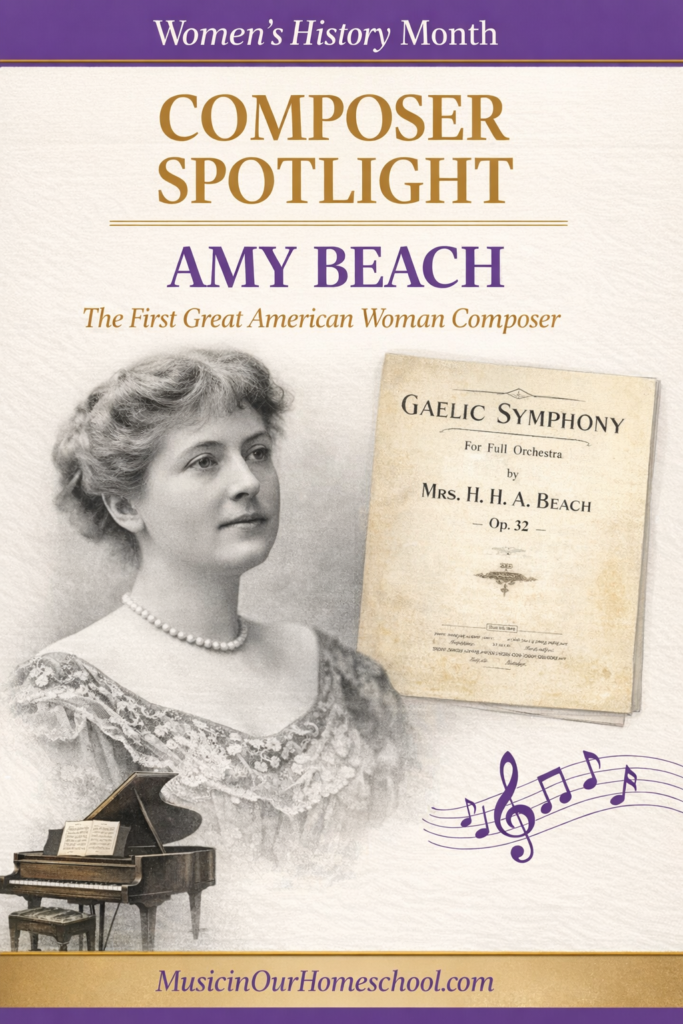
One of the most important names your homeschool should know is Amy Beach.
Amy Beach was not just a “woman composer.” She was a groundbreaking American composer who wrote symphonies, choral works, chamber music, piano concertos, songs, and even an opera—at a time when women were rarely encouraged to do so.
Her story is inspiring, her music is beautiful, and her life offers meaningful lessons for homeschool families of all ages.
A Child Who Could Not Stop Hearing Music
Amy Beach was born in 1867 in the small town of Henniker, New Hampshire. From the very beginning, it was clear that she experienced the world differently—especially when it came to sound.
As a toddler, Amy demanded specific songs, in specific keys, sung in specific ways. By the age of two, she could sing entire pieces accurately from beginning to end. Friends and relatives were amazed. Her mother, however, was worried.
Amy had perfect pitch, meaning she could hear a musical note and immediately identify it without any reference. This is an extremely rare ability, even among professional musicians.
Even more astonishing, before she was ever allowed to touch a piano, Amy was composing music entirely in her head. She imagined melodies, harmonies, and full pieces—storing them away until she finally had access to the instrument.
Her mother, Clara Cheney, was a trained musician herself but believed strongly that Amy should grow up “normally.” For a long time, the piano was strictly forbidden. But music found its way out anyway—through singing, humming, and imaginary keyboards traced in the air.
Eventually, an aunt placed four-year-old Amy at the piano bench. The moment her fingers touched the keys, the music she had been storing inside came pouring out.
Early Training and Public Performances
Once formal piano lessons began, Amy’s progress was rapid and remarkable. She studied first with her mother and later with professional teachers, quickly mastering works by Bach, Mozart, Beethoven, Chopin, Mendelssohn, and Handel.
By the age of seven, Amy gave her first public performance. As a teenager, she was already performing demanding repertoire entirely from memory—something even advanced adult pianists find challenging.
When her family moved to Boston, Amy gained access to the heart of American musical life. Boston was home to orchestras, concert halls, composers, and elite teachers, and Amy thrived in that environment.
She practiced four hours a day, excelled in academic subjects like mathematics and foreign languages, and continued to grow as a musician at an astonishing pace.
Yet despite her obvious gifts, her parents hesitated to allow her a full professional career. At the time, society believed that middle-class young women should prioritize marriage over the stage.
A Triumphant Piano Debut
Finally, at age sixteen, Amy’s mother consented to a formal public debut at Boston Music Hall. What followed was nothing short of spectacular.
Amy performed major works with orchestra—confident, composed, and technically brilliant. Critics praised her artistry, newspapers declared her a sensation, and flowers filled the stage.
Amy later described the experience as feeling like holding the reins of a powerful team of horses—fully in control and completely alive.
Shortly afterward, she published her first composition. Amy Beach had officially entered the musical world.
Teaching Herself to Compose
While Amy received excellent piano training, one of the most remarkable aspects of her story is this: she was largely self-taught as a composer.
In the late 1800s, women were rarely admitted to advanced composition programs. Most formal training happened in Europe, and even there, women faced enormous barriers.
Amy studied scores independently. She analyzed the works of Bach, Beethoven, Brahms, and other great composers. She taught herself orchestration, harmony, counterpoint, and large-scale musical form through disciplined study and listening.
At just eighteen years old, she published her first art song, With Violets, which became Opus 1. It marked the beginning of a long and productive relationship with her publisher, Arthur P. Schmidt, who published nearly all of her works for the next thirty years.
Marriage and a Shift in Focus
That same year, Amy married Dr. Henry Harris Aubrey Beach, a respected Boston physician. After their marriage, Amy reduced her public performances to just one recital per year at her husband’s request.
While this limitation restricted her performance career, it also ushered in a period of extraordinary compositional productivity.
Amy became especially well known for her art songs, a popular form of music-making in American homes at the time. Families gathered around the piano in the evenings, and solo singers performed expressive songs set to poetry.
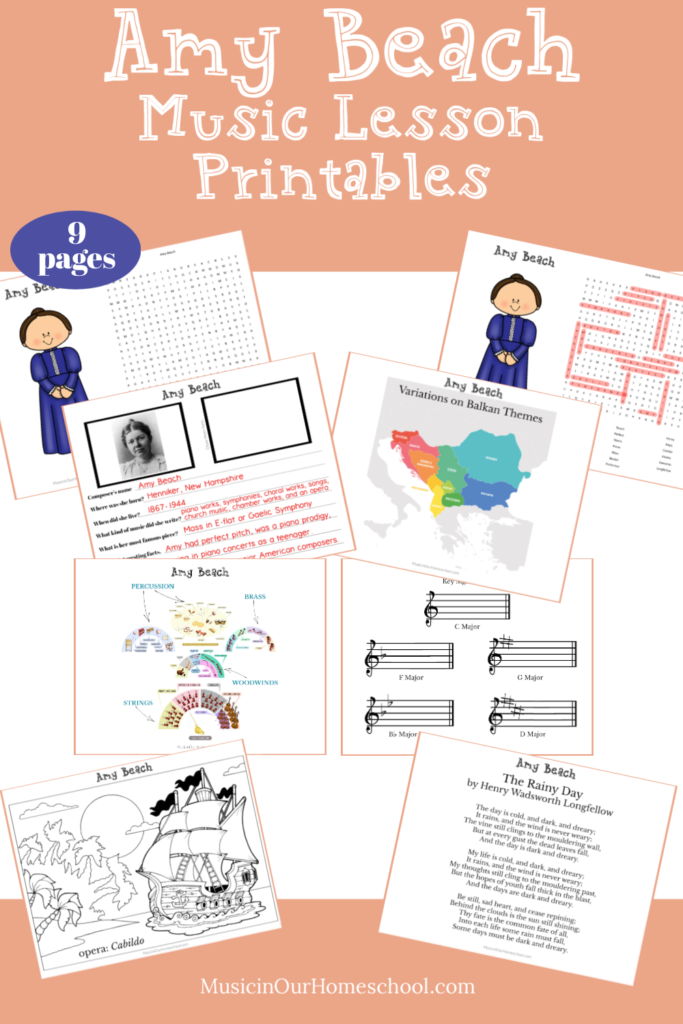
One of her most beautiful songs is her setting of Henry Wadsworth Longfellow’s poem The Rainy Day. The text moves from sorrow to hope, ending with the famous line, “Into each life some rain must fall.”
Amy’s musical setting mirrors that emotional journey perfectly.
Breaking Barriers with Large-Scale Works
Amy Beach was not content to write only small forms.
In 1892, her Mass in E-flat major, Op. 5 premiered at Boston Music Hall. This large sacred choral work established her as a serious composer capable of writing for choir and orchestra.
Then, in 1896, Amy made history.
Her Gaelic Symphony, Op. 32 premiered in Boston, making her the first American woman to compose and successfully premiere a symphony. Inspired by Irish folk music, the symphony was warmly received and performed internationally.
She also composed chamber music, including a piano quintet and violin sonata—works that remain staples of the repertoire today.
Loss, Independence, and a European Chapter
In 1910, Amy’s life changed dramatically when her husband passed away.
After his death, she resumed performing more frequently and embarked on a European tour, where she was welcomed as both a composer and pianist. This period marked a new level of independence and artistic maturity in her work.
She returned to the United States in 1914 due to the outbreak of World War I, but her music continued to evolve and deepen.
Amy Beach's Later Works and Final Years
Amy continued composing well into her later years.
In 1915, her Panama Hymn was performed at the Panama-Pacific International Exposition in San Francisco. Later, she wrote her only opera, Cabildo, inspired by a historical pirate legend set in New Orleans.
Though composed in 1932, the opera was not performed until after her death—another reminder of how long recognition for women’s work can sometimes take.
Her final song, Though I Take the Wings of Morning, reflects a lifetime of musical depth, emotional honesty, and spiritual reflection.
Amy Beach gave her final public performance in 1940 and passed away in 1944.
Why Amy Beach Belongs in Your Homeschool
Amy Beach matters—not because she was a woman composer, but because she was an excellent composer.
She wrote symphonies, concertos, chamber music, sacred works, songs, piano pieces, and opera. Amy Beach helped establish a distinctly American voice in classical music. And, she proved that women could master every musical form.
For homeschool families, her story offers powerful lessons:
Persistence and disciplined study matter
Creativity can flourish even within limitations
Music education doesn’t require perfection—just consistency
Lifelong learning is always worthwhile
Teaching Ideas for Homeschool Families
Listen to one Amy Beach piece each week during Women’s History Month
Compare her art songs to those of European Romantic composers
Discuss perfect pitch vs. relative pitch
Pair her music with poetry or American history studies
Encourage students to journal or narrate what they hear
Amy Beach’s life reminds us that music history is richer when we tell the whole story.
As you celebrate Women’s History Month in your homeschool, I hope you’ll take time to explore her music, share her story, and remind your children that creativity, persistence, and beauty can change the world—often quietly, one note at a time.
Purchase the Sound Bites: 100 Women Composers Through the Ages online course here:
Sound Bites: 100 Women Composers Through the Ages
Twenty weeks of music appreciation lessons with 100 women composers from all eras of music and from all over the world.