Celebrate the Season Through Global Song and Learn about Christmas Music Traditions from Around the World
Every December, homes around the world come alive with music. Some families hum Silent Night as snow falls softly outside, while others sing lively carols beneath palm trees or clap along to drums in candlelit churches.
Christmas music traditions reflect who we are — our cultures, climates, and communities — and every country has its own way of expressing joy and wonder through song.
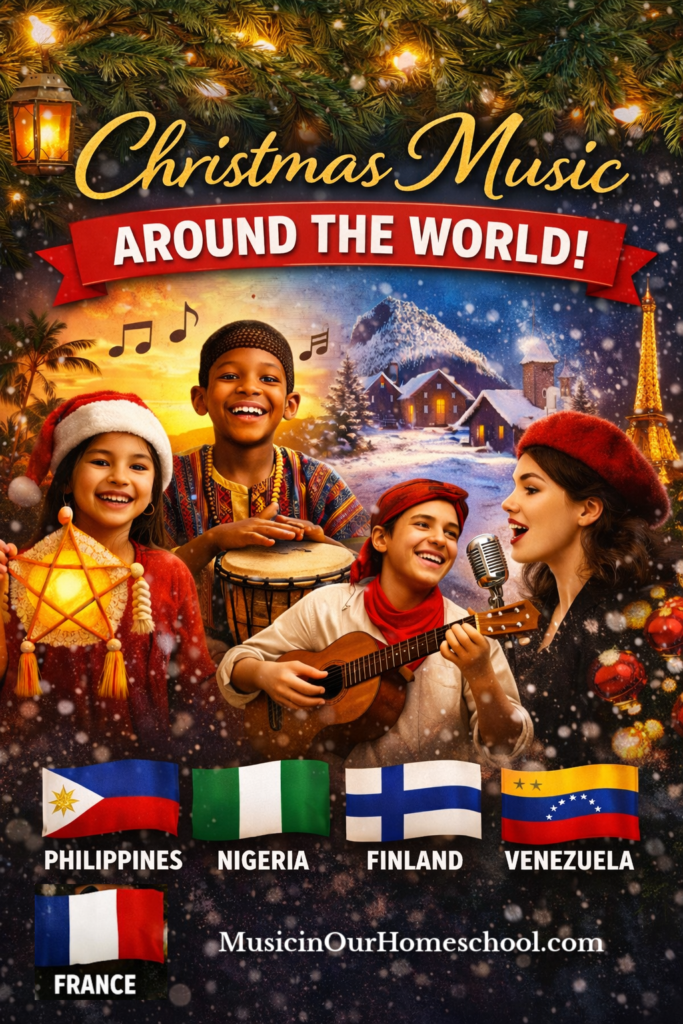
In my Music of Christmas course, there’s a special section called “Christmas Traditions Around the World,” where we explore twelve nations including Germany, Italy, Mexico, and Sweden. But today, we’re stepping beyond those and traveling to five new places that also have beautiful Christmas music stories to tell:
The Philippines — home to the world’s longest Christmas celebration
Nigeria — where drumming and harmony bring the community together
Finland — where candlelight, snow, and serene carols fill the night
Venezuela — where dancing rhythms bring joy to the streets
France — where elegant cathedral carols echo through history
Each country reminds us that Christmas joy is universal — and that music is one of the best ways to experience the season from every corner of the world.
Let’s explore how you can bring these Christmas music traditions into your homeschool this December.
The Philippines: The World’s Longest Christmas Season
If you hear Christmas carols in September, you’re probably in the Philippines! Known for the “-ber months” — September, October, November, and December — this country celebrates the world’s longest Christmas season.
From city streets to rural villages, the sound of Ang Pasko ay Sumapit fills the air. Families decorate with parols — colorful star-shaped lanterns made from bamboo and paper that symbolize the Star of Bethlehem. Entire communities hold parol festivals, complete with parades, contests, and caroling groups.
One of the most cherished traditions is Simbang Gabi (pronounced “sim-bang gah-bee”), a series of nine dawn masses leading up to Christmas Eve. Each morning before sunrise, families walk to church, light candles, and sing hymns such as Himig ng Pasko or Pasko Na Naman.
Listening Suggestions:
Ang Pasko ay Sumapit – traditional Filipino carol
Pasko Na Naman – joyful Tagalog song welcoming Christmas
Homeschool Activities:
Cultural Comparison: Listen to Ang Pasko ay Sumapit and Joy to the World. How are they alike? How are they different in rhythm, tone, and language?
Hands-On Art: Make paper parol lanterns from colored tissue paper and popsicle sticks. Hang them in your learning space.
Geography Study: Find the Philippines on a map. Discuss its tropical weather — does that change how people celebrate Christmas?
Writing Prompt: “If the Christmas season lasted four months in our house, what would that feel like?”
The Philippines reminds us that Christmas joy can be long, loud, and full of community — a season of togetherness that stretches far beyond a single day.
Nigeria: Joyful Drums and Call-and-Response Carols
In Nigeria, Christmas is a vibrant celebration of faith, family, and rhythm. Church services overflow with song and dance, and communities gather for feasts filled with traditional dishes like jollof rice and fried plantains.
What makes Nigerian Christmas music so unique is its energy. Choirs sing in English, Yoruba, or Igbo, often accompanied by percussion instruments such as the talking drum, shekere (a beaded gourd shaker), and udu (a clay pot drum).
One carol beloved worldwide is Betelehemu. Though often performed by Western choirs, its origins are deeply Nigerian — written by a Yoruba composer and adapted by choir director Wendell Whalum. The song features a strong call-and-response structure, reflecting how community and conversation are central to African music.
Listening Suggestion:
Betelehemu – Nigerian Yoruba carol performed by a children’s or college choir
Homeschool Activities:
Rhythm Play: Create percussion instruments from household items (an oatmeal container for a drum or a water bottle filled with rice for a shaker). Try echoing short rhythmic phrases to mimic call-and-response singing.
Movement: Clap or dance along while listening to Betelehemu. Encourage children to move with the beat — it’s almost impossible not to!
Cultural Study: Locate Nigeria on a map. Discuss its languages, climate, and traditions.
Reflection Question: How do you think rhythm communicates joy in music?
Finland: Candlelight and Calm
In Finland, Christmas arrives in a hush. Snow covers the forests, candles glow in windows, and families gather quietly to listen to carols.
Finnish Christmas music is peaceful and reflective. One of the most loved carols, Sylvian Joululaulu (“Sylvia’s Christmas Song”), tells of longing for home and peace. Another, En etsi valtaa, loistoa (“I Seek No Power, No Glory”), expresses humility and gratitude — it’s the opposite of flashy or loud.
Each Christmas Eve, the city of Turku reads the “Declaration of Christmas Peace,” a custom that has continued since the 1300s. The proclamation is followed by bells ringing across the town and choirs singing softly.
Listening Suggestions:
Sylvian Joululaulu – Finnish carol of nostalgia
En etsi valtaa, loistoa – quiet hymn of faith
Homeschool Activities:
Quiet Listening: Light candles and play Finnish carols while your children draw or write. Notice how calm music influences focus.
Composer Connection: Introduce Jean Sibelius and his piece Finlandia, known for its serene strength.
Poetry Prompt: Ask your students to write a short poem describing what “peace sounds like.”
World Cultures: Discuss why people living in cold, dark climates might write calmer, slower music.
Finland’s Christmas traditions invite us to slow down. In a busy world, they remind us that stillness can also be joyful.
Venezuela: Dancing to “El Burrito Sabanero”
In Venezuela, Christmas bursts with rhythm! Folk traditions and Catholic faith combine in two musical styles: Gaita and Aguinaldo.
Gaita songs are lively, with drums, maracas, and the small four-string cuatro guitar. Their upbeat tempo makes them favorites at festivals and family gatherings. Aguinaldo songs, meanwhile, are similar to carols — groups travel from house to house singing about the Nativity story, much like carolers in other parts of the world.
Perhaps the best-known Venezuelan Christmas song is El Burrito Sabanero — “The Little Donkey from the Savannah.” The lyrics describe a boy riding his donkey to Bethlehem. Its playful rhythm and repetitive melody make it an easy favorite for children.
Listening Suggestion:
El Burrito Sabanero
Homeschool Activities:
Sing and Play: Learn El Burrito Sabanero together. Use rhythm sticks, maracas, or homemade shakers.
Geography Link: Locate Venezuela on the map and note how warm weather influences their outdoor celebrations.
Cultural Extension: Look at traditional Venezuelan Christmas foods like hallacas (similar to tamales) and talk about how music and food both bring people together.
France: Carols of Grace and Grandeur
France’s Christmas music carries centuries of history, elegance, and devotion. Some of the most beloved carols we sing today were born in French cathedrals and small villages.
Il est né, le divin Enfant (“He Is Born, the Divine Child”) is one of the most joyful French carols. With its lilting rhythm and tambour-like accompaniment, it sounds like a happy procession welcoming Christ.
Another masterpiece is Minuit, Chrétiens — better known in English as O Holy Night. Written by composer Adolphe Adam in 1847, this song quickly became a worldwide favorite. Interestingly, its lyricist, Placide Cappeau, was not a clergyman but a wine merchant and poet. When his work was translated into English by John Sullivan Dwight, it spread across America and beyond.
Many French carols are accompanied by pipe organs or choirs in echoing cathedrals. The acoustics turn every note into something almost heavenly.
Listening Suggestions:
Il est né, le divin Enfant – traditional French carol
Minuit, Chrétiens (O Holy Night) – Adolphe Adam
Homeschool Activities:
Language Study: Compare the French and English lyrics of O Holy Night. What words sound similar? How do translations change meaning?
Art Connection: Look at photos of Notre Dame Cathedral at Christmas and discuss how architecture shapes sound.
Music Practice: Try singing the melody of Il est né, le divin Enfant in French. (Find it in Christmas Carols Made Easy here.)
French Christmas music is a reminder that beauty and reverence belong together. Its elegance draws listeners into reflection and wonder.
Why Study Christmas Music Around the World?
Exploring how other cultures celebrate Christmas through music helps our children understand that the same story — the birth of Christ and the joy of giving — sounds beautifully different everywhere.
Each country adds its own flavor:
The Philippines offers community and light.
Nigeria brings rhythm and movement.
Finland teaches peace and stillness.
Venezuela celebrates with laughter and dance.
France gives us grandeur and beauty.
When your homeschool studies global Christmas music, you’re not only teaching music appreciation — you’re also building cultural awareness, geography knowledge, and empathy.
These small, 15-minute experiences — just like the lessons inside Music in Our Homeschool — can make December meaningful without overwhelming your schedule.
Continue the Journey Inside the Music of Christmas Course
If you enjoyed this peek into global Christmas music, you’ll love the full Music of Christmas course.
It includes:
Three years of lessons — Christmas Music Lessons, Christmas Traditions Around the World, and Traditional Lessons and Carols
Music appreciation, art connections, and printables
Ready-to-use 15-minute lessons perfect for your December “Christmas School”
Interactive activities that require no prep — just press play and learn
In the “Christmas Traditions Around the World” section, you’ll explore twelve more countries — from Germany to Egypt — each with its own carols, customs, and instruments. You can pair that with today’s countries to create a truly global celebration of music in your homeschool.
This December, let your family experience the world through the songs of Christmas. You’ll find that, no matter where the music comes from, its message is the same: joy, peace, and togetherness.
Get the Music of Christmas online course here:
Music of Christmas Course
Fun Music Lessons to Get You and Your Kids in the Holiday Spirit