About eleven years ago, our family joined a new homeschool co-op just as my kids were beginning their studies of 20th-century history. As I looked ahead at what they would be learning—world wars, cultural upheaval, sweeping social change—I knew something essential couldn’t be left out.
They needed music.
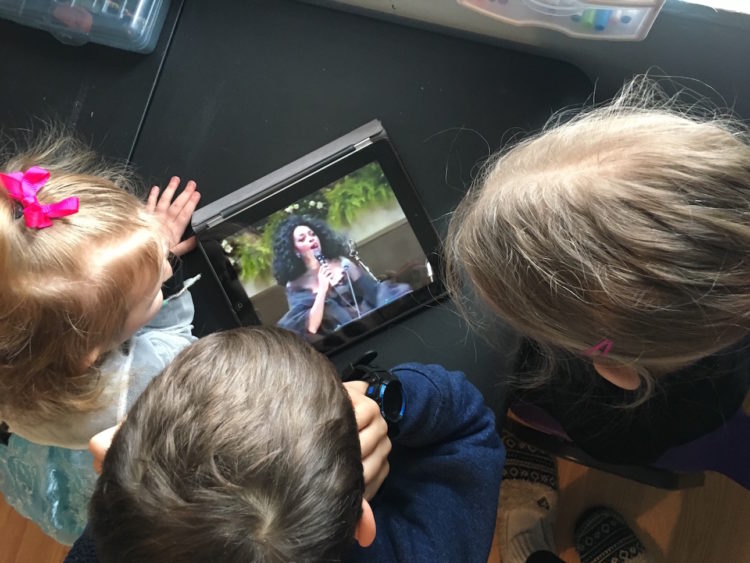
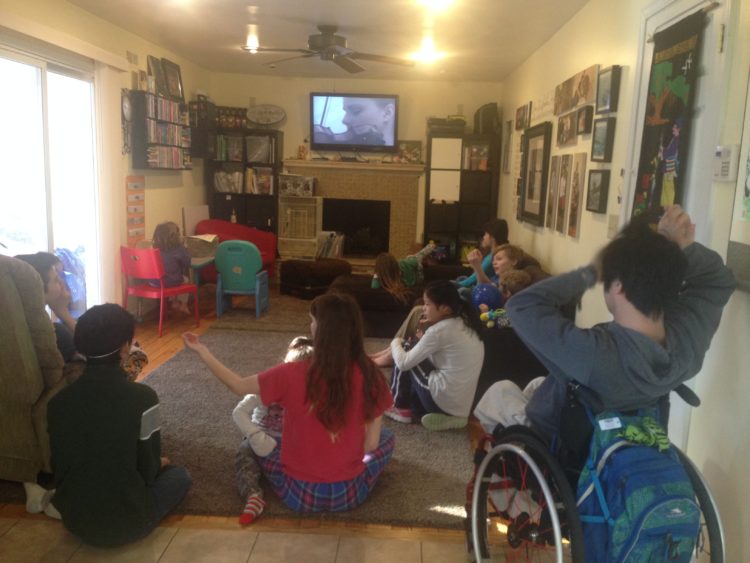
So that summer, I began researching in earnest. I listened, read, studied biographies, and gathered resources, determined to weave music history right alongside their history studies. When fall arrived, I taught a 20th-century music appreciation class at our homeschool co-op, working with students from kindergarten all the way through high school.
What happened surprised me.
Students lit up when they recognized familiar styles, laughed at unexpected modern sounds, and began making connections between the music they were hearing and the history they were studying. That co-op class became something special—and eventually, something bigger.
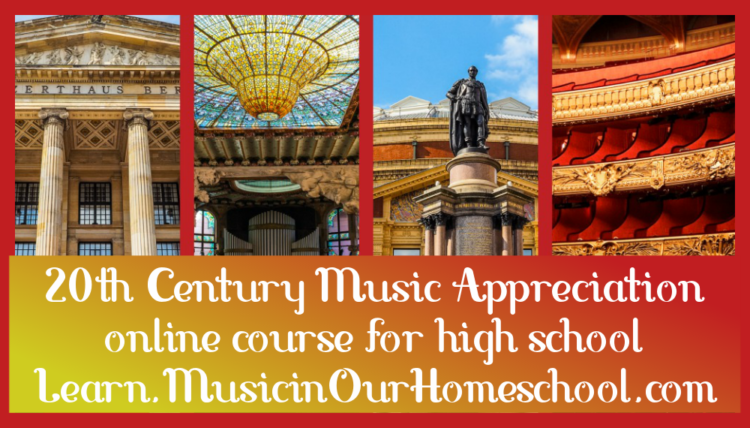
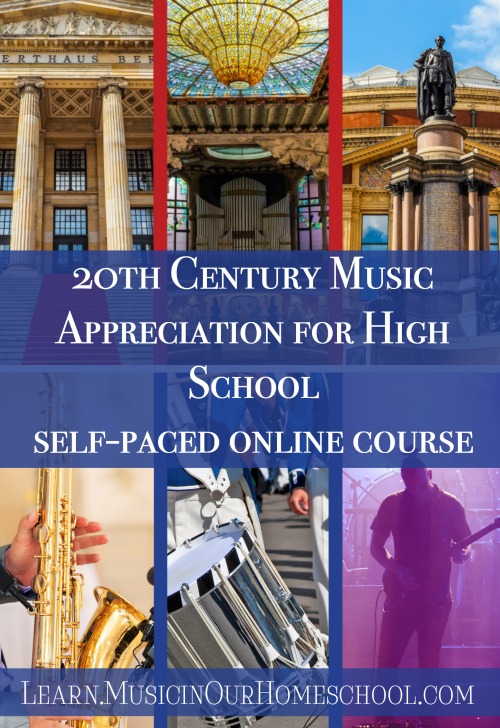
The 20th-Century Music Appreciation for High Schoolcourse
Over time, I transformed those lessons into a self-paced online course called 20th-Century Music Appreciation for High School. And after using it year after year, with students of all ages, I can confidently say this: it’s one of the very best resources I know for bringing 20th-century history to life.
History isn’t just about what happened. It’s about how people felt while it was happening. And music—more than almost any other art form—captures the emotions, tensions, hopes, fears, and creativity of the people living through those moments.
That realization eventually led me to create what is now my 20th-Century Music Appreciation course. But it all started with a simple question:
What if our students could hear history instead of just reading about it?
Why Music Matters in History Studies
The 20th century was one of the most dramatic and fast-changing periods in human history. Think about everything packed into just 100 years:
Two World Wars
The Great Depression
The Civil Rights Movement
Massive technological advances
The rise of film, radio, Broadway, and recorded music
Cultural experimentation and rebellion against tradition
Music didn’t exist on the sidelines of these changes—it responded directly to them.
When students listen to the music of an era, they begin to understand history in a deeper way. Music provides emotional context. It shows how people processed war, celebrated prosperity, questioned authority, and expressed identity.
Suddenly, history feels real.
The Soundtrack of the Early 20th Century
At the start of the century, America was finding its musical voice. Marches by John Philip Sousa reflected national pride and public life, while the ragtime piano music of Scott Joplin captured the energy of a changing society.
Ragtime wasn’t just catchy—it represented new rhythms, new freedoms, and a break from European musical traditions. Students can hear optimism and motion in this music, which pairs beautifully with studies of industrial growth and early modern America.
Jazz, Big Band, and Cultural Change
As the century progressed, jazz emerged as a powerful cultural force. Born in African American communities, jazz became the sound of the Roaring Twenties and beyond. Improvisation, syncopation, and swing reflected freedom, innovation, and social change.
Big band music later became associated with World War II, offering both escapism and unity during difficult times. These styles aren’t just “fun extras”—they are historical documents in sound.
Classical Music Responds to a Troubled World
The 20th century also pushed classical music in bold and sometimes unsettling directions.
Composers were living through war, political oppression, and rapid societal change. Their music reflects that tension. The symphonies of Gustav Mahler stretch emotional boundaries, while the works of Dmitri Shostakovich reveal what it meant to create art under fear and censorship in Stalinist Russia.
When students learn that Shostakovich composed while worried about arrest—or worse—his music suddenly carries a weight that no textbook paragraph can convey.
This is where music appreciation becomes a powerful form of historical empathy.
Broadway, Opera, and Musical Theater
The 20th century also transformed musical storytelling. Opera continued through composers like Puccini, while musical theater evolved into a uniquely American art form.
Students encounter works by George Gershwin, who blended jazz and classical traditions, and later Leonard Bernstein, whose West Side Story reflects social tensions, immigration, and urban life in postwar America.
Musical theater becomes a bridge—connecting history, literature, music, and culture in a way students immediately recognize and enjoy.
Film Music and the Modern World
As technology advanced, music moved into new spaces—especially film. Movie scores became one of the most influential musical forms of the century.
The cinematic music of John Williams shows students how orchestral traditions continued in modern storytelling. Film music offers an accessible entry point for students who might feel intimidated by classical music but instantly connect through movies they already love.
This helps students see continuity rather than division between “old” music and modern culture.
Why This Works So Well in a Homeschool
One of the biggest benefits of studying 20th-century music alongside history is flexibility.
Music appreciation doesn’t require advanced musical training. Parents don’t need to be experts. Students don’t need to read music. All they need to do is listen, observe, and discuss.
That’s why this approach works beautifully for:
Multi-age families
Busy homeschool schedules
Teens earning fine arts credit
Younger students who just want exposure and enjoyment
Music appreciation can be adapted up or down, deepened for high schoolers, or kept light and engaging for younger children.
A Richer Way to Teach History
When students listen to protest songs from the 1960s, they understand the Civil Rights Movement differently. As they listen to music written under political oppression, they grasp the cost of freedom. When they explore bold musical experimentation, they see how artists respond when the world feels unstable.
Music adds depth, emotion, and humanity to history studies.
And that’s why I believe 20th-century music appreciation isn’t an extra—it’s the perfect companion to modern history.
If your homeschool is heading into the 20th century, or your high schooler needs a fine arts credit that truly connects with what they’re already studying, music appreciation may be exactly what’s missing.
Because history isn’t silent—and when we let our students hear it, everything changes.
“We've been using the 20th century music course and we are really enjoying it. It was exactly what I was looking for to go along with our study of the 20th century. I was trying to put all of the resources together myself, but it was a lot of work. So, this has been worth the money!” ~ Angela
What is special about the 20th-Century Music Appreciation course?
It's self-paced
It's yours forever
You can use it with all the kids in your home/classroom
You can use it in a school or co-op with a license (sold separately)
It's fun!
All videos to listen to the music are embedded
High schoolers can earn 1/2 credit in Fine Arts
It can easily be adjusted for grades K-8
Notebooking pages are included
What do you learn in the course?
Here are a few of the composers/styles you'll learn about.
Marches
Ragtime
Jazz
Rock and Roll
Opera
Symphonies
Musical Theater
Piano Concertos
Puccini
Mahler
Bernstein
Lloyd Webber
Gershwin
Shostakovich
Schoenberg
and so many more!
Why Study Music Appreciation alongside 20th Century History?
The arts, including music, drama, art, and story (books and movies) are always affected by the events surrounding their creators. Historical events in the 20th century led composers to write in new styles. In the online course, you'll learn about the folk songs of the 1960s which were written in protest to the Vietnam War. You'll hear new styles of opera and ballet that were set in modern times, making them vastly different from their predecessors in the previous centuries.
Brand new genres were created such as movie music. You'll also learn about how historical events affected the composers themselves, causing them to write in a particular manner–such as those who feared for their lives under the tyrannical regimes in Stalinist Russia and Nazi Germany. I can't think of a better way to learn about history than to listen to the music written during the times while studying it.
I can't think of a better way to learn about history than to listen to the music written during the times while studying it.
Purchase the 20th Century Music Appreciation course here:
20th Century Music Appreciation for High School
36 Lessons to Earn a 1/2 Credit in High School Fine Arts