This hands-on lesson helps children explore the instrument families and begin organizing what they see and hear in orchestral music. In this post, I’ll also share a second free beginner music lesson that supports this work by helping children understand how music itself is organized.
The orchestra is one of the richest musical experiences your child could ever step into.
Inside the orchestra, children hear soaring melodies, powerful rhythms, hundreds of years of musical history, emotional storytelling, and an incredible variety of instruments and sounds. Through orchestral music, children can explore culture, creativity, listening skills, and musical understanding all at once.
It’s a world that naturally invites curiosity.
Yet for many homeschool parents, the orchestra can also feel intimidating.
Where do you even begin? How do you help a child make sense of so many instruments and sounds? How do you turn orchestra listening into something meaningful instead of confusing background noise?
For homeschool families looking for simple music lessons for kids, the answer is not more information.
The answer is strong musical foundations.
When children understand how music works and what music is made of, the orchestra stops feeling overwhelming and starts becoming an open door.
What Are Strong Music Foundations?
Before children can truly engage with orchestral music—or learn to read, play, and create music—they need clear foundations.
Strong music foundations don’t begin with long theory lessons or memorization. They begin with helping children organize musical experiences in their minds.
Two of the most important beginner foundations for meaningful music learning are:
understanding the orchestra and instrument families (what music is made of)
understanding the music alphabet (how music works)
These are not separate tracks.
They work together to give children the framework they need to truly engage with music.
Together, these ideas give children a mental framework for both music listening and music reading.
Foundation #1: Understanding the Orchestra — What Music Is Made Of
Once children are introduced to the world of orchestral music, one of the most powerful foundations you can build is helping them understand what creates the sounds they hear.
The orchestra is made up of many different instruments, each with its own sound, shape, and role. For young learners, this variety can feel overwhelming without a structure to organize it.
That’s why musicians group orchestra instruments into four main families:
Strings
Woodwinds
Brass
Percussion
This system gives children a mental map.
Instead of seeing the orchestra as a random collection of instruments, they begin to understand relationships—which instruments are similar, how they are played, and how they fit together.
This framework is what allows later listening activities, composer studies, and performances to truly make sense.
Before children can deeply engage with orchestral music, they need visual familiarity and vocabulary. They need to recognize instruments, understand how they are grouped, and feel confident talking about what they see and hear.
A Free Beginner Orchestra Lesson for Kids: Orchestra Flashcards & Sorting
To support this foundation, I created a free orchestra flashcard and sorting activity for homeschool families.
This free resource is designed to help children build a clear mental picture of the orchestra before moving into deeper study.
Instead of overwhelming students with facts, it focuses on recognition, organization, and understanding.
The free packet includes:
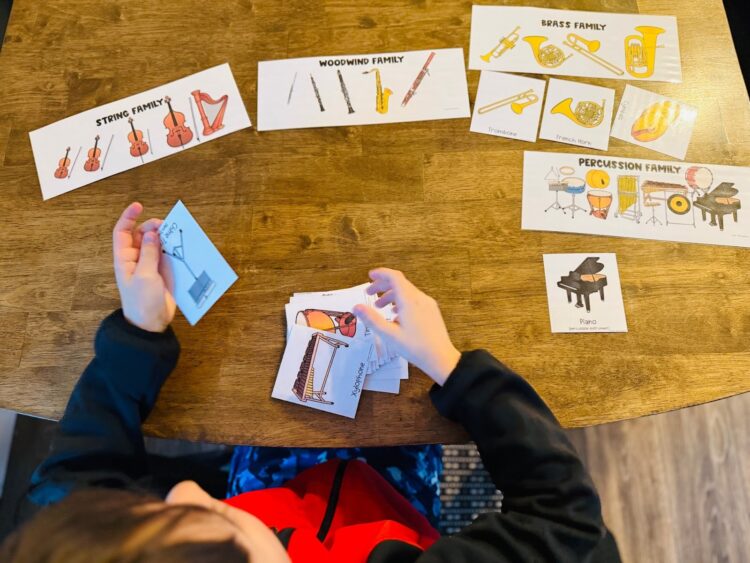
printable orchestra instrument flashcards
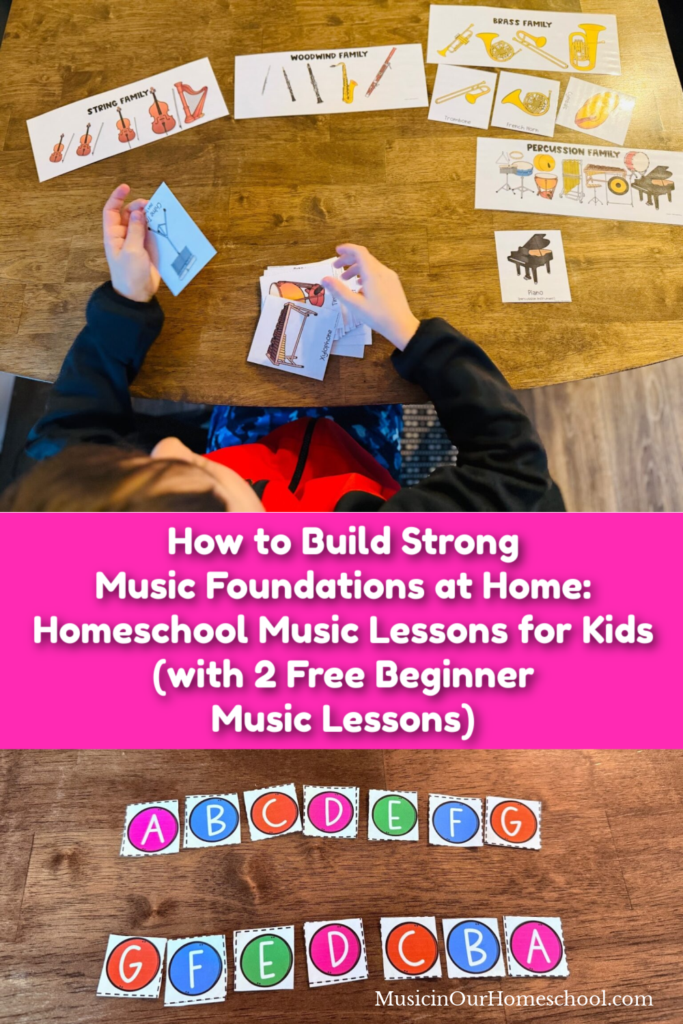
instrument family cards (Strings, Woodwinds, Brass, Percussion)
a hands-on sorting activity
a simple print-and-go format
Children use the cards to:
• learn instrument names • sort instruments into families • compare how instruments look and are played • prepare for orchestra listening activities
Homeschool families often use this resource:
• as a weekly music exploration activity • before watching orchestra performance videos • as part of a composer or classical music unit • as a simple introduction to orchestra instruments
This free lesson is designed as the first step in a complete orchestra course called Explore the Orchestra, which guides students beyond recognition into true understanding through instrument studies, listening lessons, and interactive orchestra activities.
Foundation #2: The Music Alphabet — Also a Required Foundation
Understanding what instruments create the sounds is one essential foundation.
But for children to truly grow inside the world of music—for listening, playing, and eventually reading—there is another foundation that is just as important.
They must understand how music itself is organized.
This is where the music alphabet comes in.
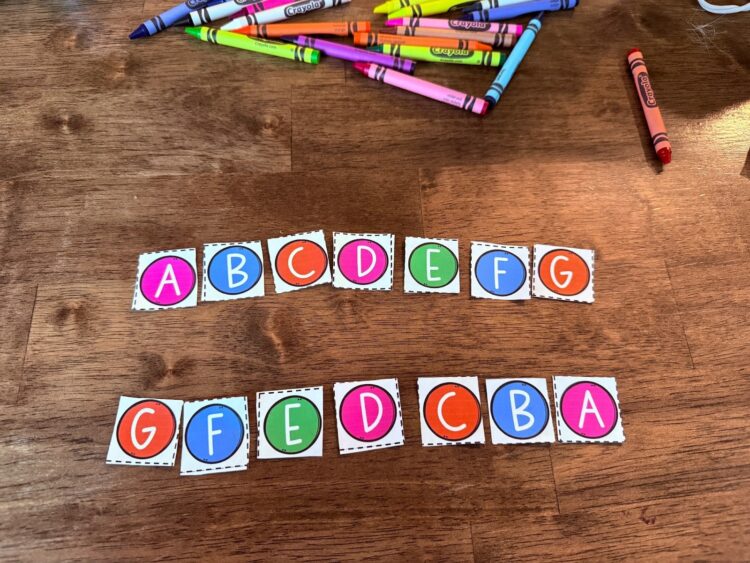
In Western music, notes are named using the first seven letters of the alphabet:
A B C D E F G
After G, the pattern simply repeats.
These seven letters are the building blocks for everything your child will eventually read on a staff, play on an instrument, sing, or compose.
Without understanding this repeating system, the staff has no meaning. Notes become symbols to memorize instead of ideas to understand.
When children understand that notes follow a repeating order and move higher and lower, the staff stops being a collection of confusing symbols and starts becoming a logical system.
Understanding the music alphabet gives children a mental map. It allows them to recognize patterns, predict what comes next, and connect what they see to what they hear.
Many beginner approaches skip this foundation. Children are often asked to memorize note names on lines and spaces before they understand what those notes represent.
When children understand how the music alphabet works first, music reading becomes clearer, more natural, and far less frustrating.
A Free Beginner Music Lesson for Kids: Learn the Music Alphabet
To support homeschool families, I created a short free lesson designed specifically to build this foundation.
This free lesson helps children understand how notes work before they are asked to memorize them.
Instead of drills, it focuses on musical thinking.
The lesson includes:
an interactive drag-and-drop activity where children explore note order, direction, and repetition
a printable worksheet that reinforces understanding
clear, kid-friendly instruction and visuals
In this free beginner music lesson, children:
learn the music alphabet forwards and backwards
explore how notes move up and down
connect written notes to musical motion
Because homeschool days are already full, the lesson is intentionally short, simple, and flexible. Families often use it as:
a stand-alone homeschool music lesson
a pre-piano foundation
preparation for reading notes on the staff
This lesson is also the first step in a full homeschool music curriculum called The Grand Staff Adventure, which guides students from early foundations into confident treble and bass clef reading through games, visuals, listening, and creative activities.
Why These Two Foundations Work So Well Together
Understanding the orchestra builds children’s awareness of sound, instruments, and musical context.
Understanding the music alphabet builds children’s awareness of patterns, structure, and musical relationships.
Together, they give children:
• listening readiness and reading readiness • vocabulary and visual familiarity • structure and meaning • confidence and curiosity
Instead of jumping into memorization, children develop understanding first.
That understanding is what makes future music lessons smoother, richer, and far less frustrating.
Why Homeschool Is the Perfect Place to Begin Music
Homeschooling allows music learning to grow naturally.
At home, homeschool music lessons can:
• move at your child’s pace • include listening, discussion, and exploration • focus on understanding instead of testing • grow gently and joyfully over time
Many parents ask how to teach music at home when they don’t read music themselves — and the answer is that strong foundations make homeschool music lessons simple, approachable, and effective.
You don’t need to be an expert. You are not behind. Strong foundations now make everything easier later.
Two Simple Ways to Start Music at Home
If you would like gentle, supportive ways to begin music learning in your homeschool, you can start with these two free lessons:
Both are designed to help homeschool families build true musical understanding—clearly, simply, and with confidence.
About the Author
Abigail Mettry is a classically trained pianist, composer, and music educator with a Master’s degree in Music and Kodály Level I & II certification. She has taught K–5 general music, private piano, and university-level piano, and now creates engaging, sequential homeschool music curriculum at Wildflower Music. Abigail is passionate about helping families build true musical understanding in children through developmentally aligned lessons that make music learning clear, joyful, and achievable.