If you’ve ever thought, “Music is important, but I just don’t have time to do it well,” you’re not alone. That's where our 15-minute music method shines.
Almost every homeschool parent I talk to believes music matters. They want their children to appreciate it, understand it, and feel comfortable around it. Yet music is one of the first subjects to quietly slip off the schedule. Not because parents don’t care—but because it feels hard to fit in, hard to do well, or hard to sustain.
Over the years, I’ve discovered something important: Most homeschool parents don’t struggle with motivation. They struggle with sustainability.
Music education in the homeschool often falls into one of two extremes. On one end, we try to do too much. We plan long lessons, ambitious projects, or detailed units that feel exciting at first—but quickly become overwhelming. Eventually, we burn out.
On the other end, music feels confusing or intimidating, so we keep putting it off, telling ourselves we’ll “start later” when life is calmer.
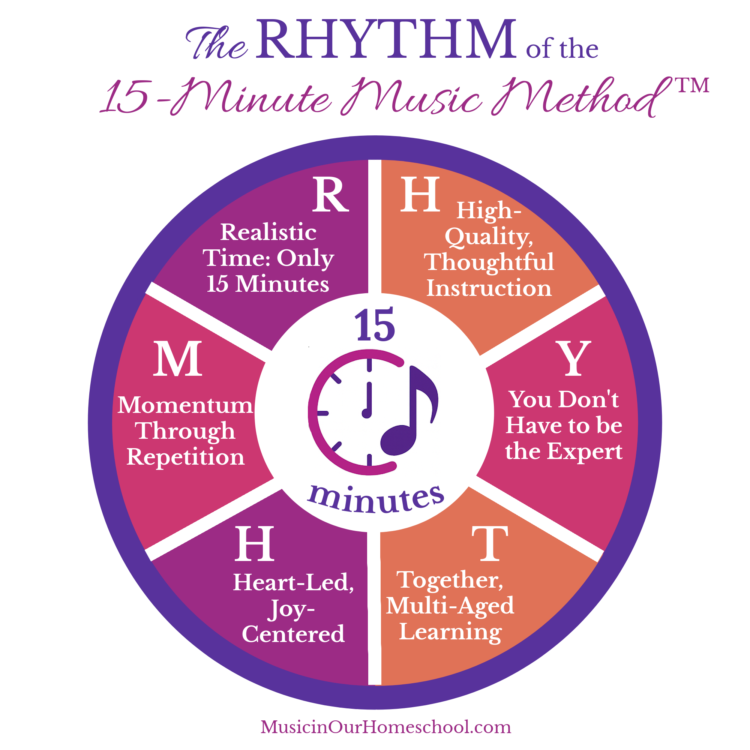
That’s exactly why I created the 15-Minute Music Method™—and the framework behind it called RHYTHM.
Music itself is rhythmic by nature. It doesn’t thrive on long, occasional marathons. It grows through short, repeated, consistent encounters over time. When we align music education with that natural rhythm, it finally begins to work in real homeschool life.
Let’s walk through each part of the RHYTHM and explore why 15 minutes truly is enough.
R — Realistic Time, Only 15 Minutes
Fifteen minutes fits real homeschool days.
It fits mornings that start late. It fits days when math takes longer than expected. It fits homes with toddlers underfoot, teenagers with jobs, and parents juggling multiple responsibilities.
Fifteen minutes is long enough to listen attentively, engage with an idea, and spark curiosity—but short enough that it doesn’t feel heavy or dreaded. When lessons are short, resistance disappears. Children are more willing to participate, and parents are more willing to begin.
One of the biggest mistakes we make in homeschooling is assuming that more time automatically equals better learning. In reality, learning happens best when attention is focused and energy is fresh. Fifteen minutes allows both.
When music fits easily into the day, it actually happens. And when it happens consistently, it becomes meaningful.
H — High-Quality, Thoughtful Instruction
Short does not mean shallow.
This is one of the most common misconceptions about homeschool music education. Many parents worry that if lessons are brief, they must be lacking depth. But high-quality instruction isn’t measured in minutes—it’s measured in clarity, intention, and design.
Thoughtfully created lessons can introduce real musical ideas in a short amount of time. Children can learn to recognize composers, hear musical patterns, understand styles, and make meaningful connections without sitting for an hour.
In fact, younger learners especially benefit from shorter lessons. Their attention spans are respected, and their curiosity remains intact. Instead of being overwhelmed, they leave wanting more—and that’s exactly what we want.
High-quality instruction focuses on what matters most and removes everything that doesn’t. It doesn’t waste time. It invites children into real musical experiences in a way that feels accessible and engaging.
Y — You Don’t Have to Be the Expert
This is a huge one.
So many homeschool parents believe that they can’t teach music because they don’t have a music background. They assume they need to read music fluently, understand theory, or know the “right” things to say.
You don’t.
One of the most freeing realizations in homeschooling is that you don’t have to be an expert in every subject. Your role is not to know everything—it’s to create opportunities for learning.
The 15-Minute Music Method is built on the idea that music education should be guided and done-for-you. The teaching is built into the lesson. The listening is selected. The questions are provided. The structure is already there.
Your job is simply to show up, press play, and participate alongside your children if you choose. You model curiosity, not mastery. And that is far more powerful.
When children see parents learning with them, music becomes something shared—not something intimidating or untouchable.
T — Together, Multi-Age Learning
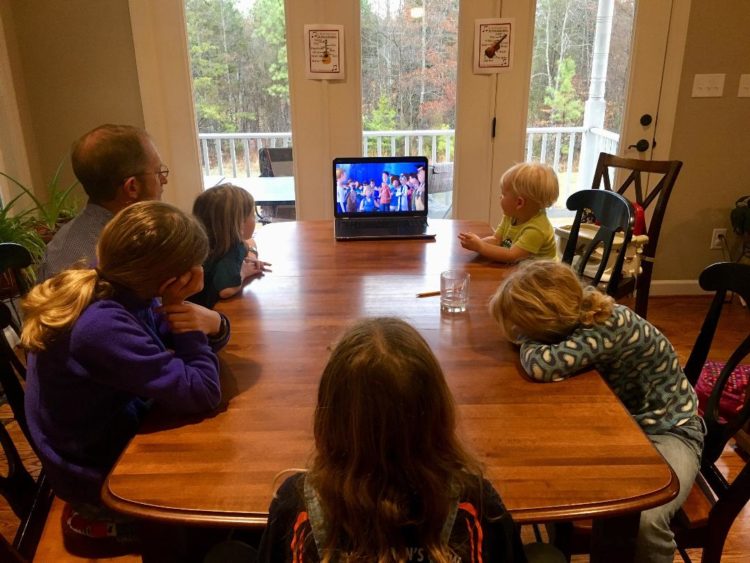
Music is one of the easiest subjects to do together as a family.
Unlike math or writing, music doesn’t require every child to be at the same skill level to participate. A preschooler, an elementary student, and a teenager can all listen to the same piece of music and come away with different insights—and that’s a strength, not a weakness.
Multi-age learning allows music to become a shared family experience instead of one more subject to divide and manage separately. It simplifies homeschooling while strengthening connection.
Each child takes what they are ready for. Younger children might enjoy the sound and mood. Older students might notice form, style, or historical context. All of it counts.
When music becomes something you do together, it naturally finds its place in your homeschool rhythm.
H — Heart-Led and Joy-Centered
Music education was never meant to be pressured.
If a child’s earliest experiences with music are marked by stress, correction, or boredom, something has gone wrong. Music is meant to connect with the heart first.
That’s why the 15-Minute Music Method begins with listening, curiosity, and enjoyment—not long lectures or technical analysis. We start with short doses that leave children feeling open and engaged.
Joy builds trust. Trust leads to interest. Interest leads to deeper learning over time.
When children associate music with warmth and connection, they remain receptive. And that receptivity creates a strong foundation for future musical growth—whether that means deeper appreciation, formal study, or simply a lifelong love of music.
Repetition builds familiarity. Familiarity builds confidence. Confidence leads to recognition and understanding. Over time, children begin to notice patterns, styles, and sounds without being explicitly taught to do so.
The growth may feel subtle week to week, but over months and years it becomes unmistakable.
Momentum doesn’t come from doing music perfectly. It comes from showing up again and again in small, manageable ways.
Why the 15-Minute Music Method Matters So Much
When music is built into your homeschool rhythm—short, consistent, joyful—it stops feeling optional. It becomes part of the culture of your home.
Children grow up comfortable with music instead of intimidated by it. They learn that music is something they can enjoy, understand, and participate in—not something reserved for experts.
And parents are freed from the pressure of “doing enough.”
If music has felt important but elusive in your homeschool, you don’t need more time. You don’t need more knowledge. You don’t need more curriculum.
You need a better RHYTHM.
Fifteen minutes, practiced consistently, is enough to build a high-quality, joyful music education that truly lasts.
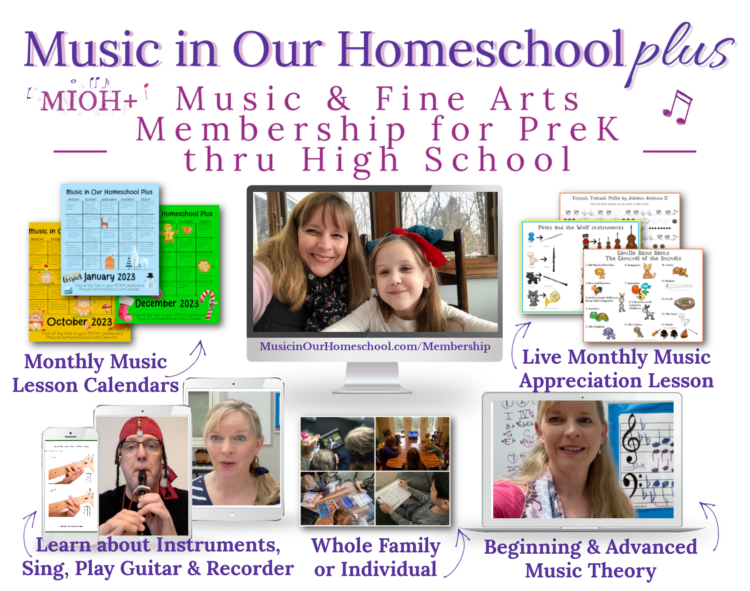
Head here to get the Basic Tier of the Music in Our Homeschool Plus membership!