Have you ever opened a piano book and noticed those sharps or flats sitting quietly at the beginning of the staff? Maybe your child asked, “What do those mean?” and you thought, I used to know… but I’m not sure I can explain it clearly anymore.
If that sounds familiar, you are not alone.
One of the most common hesitations homeschool parents have about teaching music theory is feeling unsure about the terminology. Words like key signature, major, minor, and Circle of Fifths can sound intimidating. But the truth is, the concept of a key signature is actually very logical and beautifully organized.
In a recent live lesson inside Music in Our Homeschool, we explored the question: What is a key signature? Today, I’d like to walk you through it in a clear, simple way so you can confidently explain it in your own homeschool.
What Is a Key Signature?
A key signature appears at the very beginning of a piece of sheet music. It comes right after the clef symbol (treble or bass clef) and before the time signature.
It consists of:
Sharps (♯)
Flats (♭)
Or sometimes nothing at all
Those symbols tell you which notes will consistently be sharp or flat throughout the entire piece.
Instead of writing a sharp or flat next to every single affected note, the composer places them at the beginning. That way, musicians know from the start which notes are altered.
This makes music:
Cleaner to read
Easier to understand
Faster to process
Imagine reading a book where the same spelling rule had to be written after every word. It would feel cluttered and overwhelming. A key signature simplifies everything.
Why Don’t All Songs Use the Same Key?
This is a question I love asking students.
If we can play a song in one key, why not play everything in that key?
There are several reasons:
1. Vocal Range
Different singers have different comfortable ranges. A song that is too high or too low in one key might fit beautifully in another.
If you’ve ever tried to sing along with a recording and thought, “This is too high for me,” you’ve experienced why keys matter.
2. Instrument Comfort
Some instruments are naturally easier to play in certain keys. For example, wind instruments often favor keys that align with their built-in tuning systems.
3. Mood and Color
Even though the pattern of a major scale stays the same, starting on a different pitch changes the tonal center. Musicians often describe keys as having slightly different “colors” or emotional qualities.
Keys help give music personality.
Understanding the Piano Keyboard
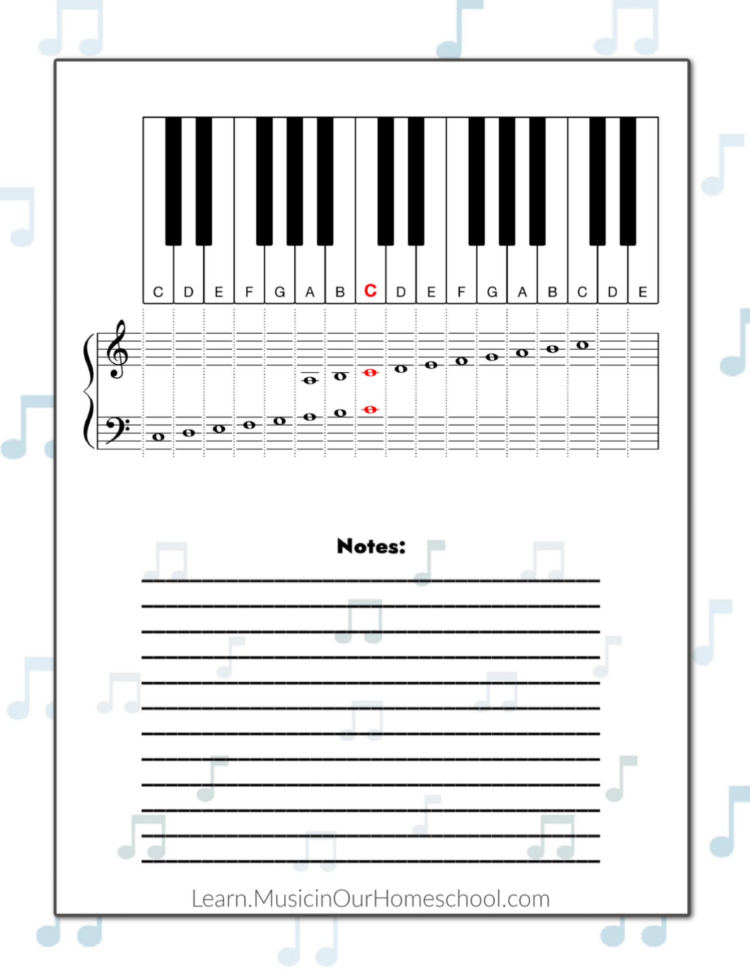
One of the easiest ways to visualize key signatures is by looking at a piano keyboard.
The piano shows us something incredibly helpful: there are 12 distinct pitches in Western music.
If we begin on C and move up by half steps (from one key directly to the next key), we get:
C C♯ / D♭ D D♯ / E♭ E F F♯ / G♭ G G♯ / A♭ A A♯ / B♭ B C again
After 12 notes, the pattern repeats.
This system became standardized in Western music around the early 1600s, at the beginning of the Baroque period. While music in other parts of the world uses different tuning systems and scales, we are focusing here on Western tonal music.
What Happens in C Major?
If you see a piece of music with no sharps and no flats, that tells you it is in C major (or its relative minor, A minor).
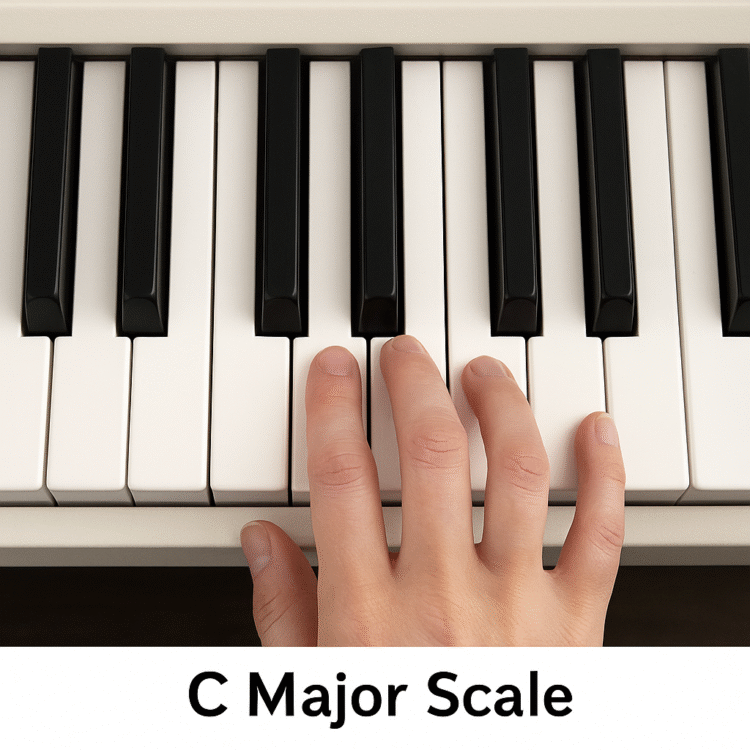
On the piano, the C major scale uses only white keys:
C – D – E – F – G – A – B – C
There are no sharps or flats needed.
That’s why C major is often the first key children learn. It’s visually simple and easy to understand.
The Pattern of a Major Scale
Here is where things get exciting. Every major scale follows the same pattern of whole and half steps:
Whole Whole Half Whole Whole Whole Half
A whole step means there is one note in between (like from C to D). A half step means there is no note in between (like from E to F).
If you start on any note and follow that pattern exactly, you will create a major scale in that key.
For example:
Starting on C → no sharps or flats needed.
Starting on F → you must include B♭ to keep the pattern correct.
Starting on G → you must include F♯.
That is why key signatures exist. They preserve the pattern.
How Key Signatures Keep Music Organized
Let’s say you are playing in the key of F major. In F major, every B must be B♭ in order for the scale pattern to stay correct.
Instead of writing B♭ every time it appears in the music, the composer simply places one flat at the beginning of the staff. That tells you: “Every B in this piece is flat unless otherwise marked.”
Without key signatures, music would look cluttered and confusing.
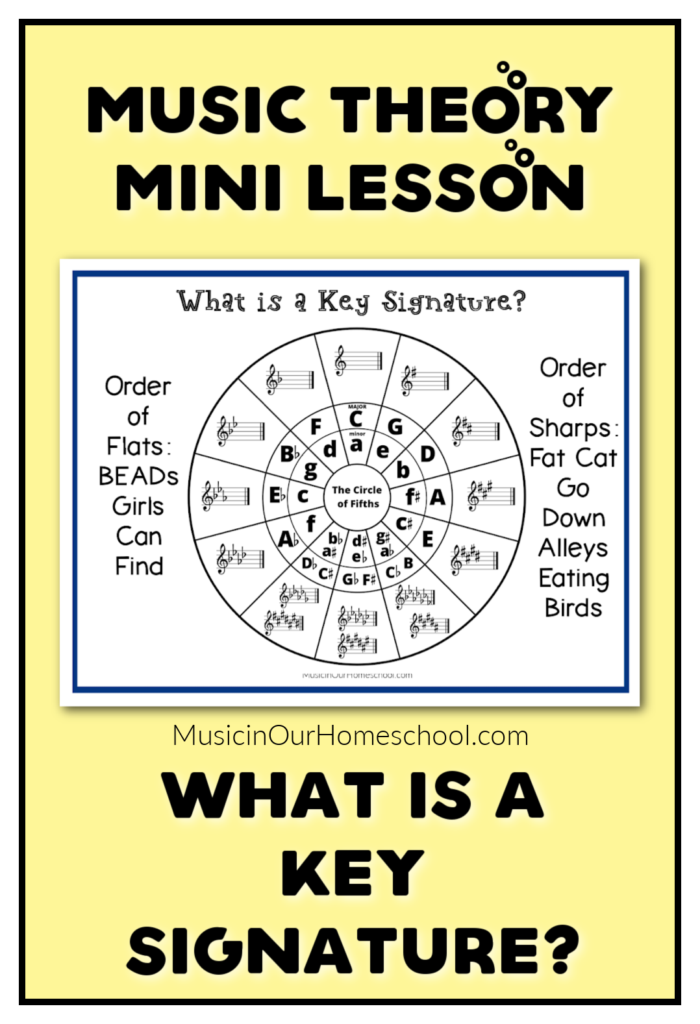
Introducing the Circle of Fifths
At some point, students begin noticing a pattern in how keys are organized.
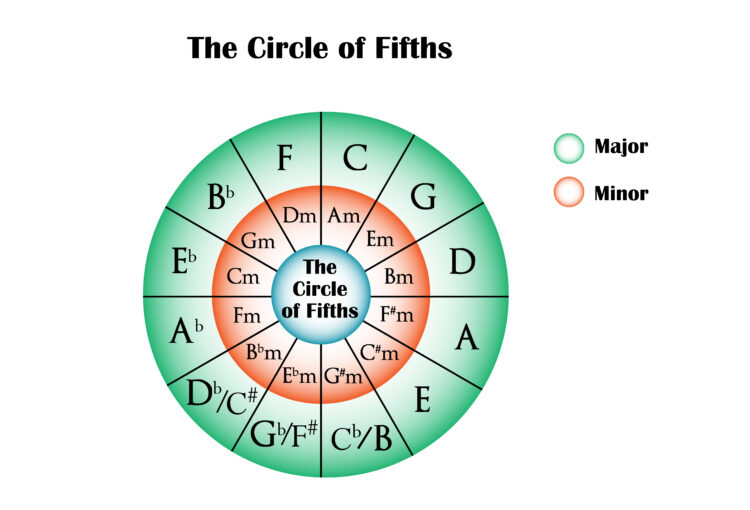
If you move up by fifths (C to G, G to D, D to A, and so on), each new key adds one sharp.
If you move the other direction, each new key adds one flat.
This relationship is shown in a visual tool called the Circle of Fifths.
The Circle of Fifths helps students:
Identify the key quickly
Understand how many sharps or flats are present
See how keys are related to one another
Recognize relative major and minor pairs
For beginners, we don’t need to memorize the entire circle immediately. But introducing it early helps children see that music is structured and logical.
Major vs. Minor: A Quick Introduction
In your child’s printable pack, you may notice both large and small letter names listed for keys.
The larger letters represent major keys. The smaller letters represent minor keys.
Major scales generally sound:
Bright
Stable
Cheerful
Minor scales often sound:
Darker
More serious
Emotional
The difference between major and minor is based on altering certain steps within the scale pattern. Even young students can begin hearing the difference.
A Simple Ear Training Game
One of my favorite activities–included on the podcast or YouTube video mini lesson– is a listening game. I sing a familiar song and stop before the final note. Then students try to sing the “home” note—the note that feels finished.
Almost always, songs end on the key they are written in. When children begin recognizing that final resting note, they are starting to internalize tonality.
And it doesn’t require complicated worksheets—just listening and singing.
Why This Matters in Your Homeschool
You might be wondering: “Is learning key signatures really necessary?”
If your child:
Plays an instrument
Sings in choir
Wants to compose
Is studying music appreciation
Plans to pursue music further
Then yes, understanding keys becomes essential.
But even beyond that, studying music theory builds:
Pattern recognition
Logical thinking
Listening skills
Mathematical awareness
Confidence in reading music
Music theory strengthens the brain in beautiful ways.
You Don’t Have to Be the Expert
One of the biggest myths in homeschool music education is:
“I can’t teach this because I don’t know it well enough.”
You don’t need a music degree to guide your child through basic theory concepts.
You simply need:
Clear explanations
Good printables
Structured lessons
Consistency
That’s exactly why I created these live music lessons and printable packs—to remove the overwhelm and give you ready-to-use tools.
Taking the Next Step
This blog post is based on a shortened excerpt from a full 30-minute live lesson on key signatures.
You might like to go deeper into the concept. Options include:
Download the printable pack (see below)
Access additional activities (in the Beginning Music Theory courses, see below)
Join our monthly LIVE music and painting lessons (February's is listed below)
Provide consistent music education in just 15 minutes a day!
Music theory does not have to be intimidating. When broken into small, clear steps, it becomes logical, enjoyable, and empowering.
And when your child looks at sheet music and says, “Oh! That’s in F major because there’s one flat,” you’ll know you’ve built something meaningful!
Purchase the LIVE Music and Art Lessons for February 2026 here (the full “What is a Key Signature” 30-minute lesson):
**Only available for purchase through Feb. 28, 2026.
Music and Art of America: 250 Years of Freedom
Music and Art of America: 250 Years of Freedom invites students on a powerful journey through American history by exploring how music and visual art have told the story of courage, struggle, faith, and innovation from the Colonial era to today. Each 15-minute music lesson connects a defining musical style with an iconic artwork to reveal how creative expression both shaped and reflected the nation’s pursuit of freedom. Through listening, reflection, and visual inspiration, students discover that the soundtrack—and the canvas—of America is as diverse, vibrant, and resilient as its people.
Purchase the Beginning Music Theory for Elementary course here:
Beginning Music Theory for Elementary
The perfect introduction to music for young learners! This engaging online course is designed specifically for elementary students and homeschoolers to learn beginning music theory through fun, interactive lessons. Kids will explore treble and bass clef notes, rhythm, solfege, piano basics, key signatures, dynamics, and more—making it easy to build a strong foundation in music education with just a few minutes a day.