If you’re homeschooling a teenager, you’ve probably asked this question at least once:
How do I make music appreciation interesting for teens—and not just another thing they tolerate?
You might have a teen who loves music but only listens to what’s trending on TikTok. Or maybe you have a teen who rolls their eyes at the mention of Mozart and thinks music appreciation sounds boring, outdated, or pointless.
If that’s you, take a deep breath. You’re not failing, and you’re definitely not alone.
As a homeschool mom of eight and a longtime music teacher, I’ve wrestled with this exact challenge. I’ve seen seasons where music felt joyful and natural—and seasons where it quietly disappeared under piles of math, writing, and science.
The good news? Music appreciation can work beautifully for teens when we approach it differently.
Why Music Matters So Much in the Teen Years
Teenagers are in a unique season of life. They’re discovering who they are, what they believe, and where they belong. Music often plays a huge role in that process.
Music becomes their emotional language. It’s one of the major ways they process joy, stress, grief, hope, and identity.
When we help teens understand music—how it’s built, where it comes from, and why it affects them—we give them tools to engage more deeply not just with sound, but with history, culture, and even themselves.
But here’s the key: If music appreciation feels dry, disconnected, or forced, teens will shut down.
So let’s talk about what actually works.
The Breakthrough: Short, Consistent Music Moments
For many years, I believed that music lessons had to be long and formal to “count.” I imagined hour-long lessons with worksheets, notebooks, and elaborate plans.
And because I couldn’t make that happen consistently, music often didn’t happen at all.
My breakthrough came when I asked a simple question:
What if music didn’t need an hour? What if 15 minutes were enough?
That question changed everything.
Short, consistent music moments—listening to one piece, discussing a song, watching a short performance, or noticing instruments during a car ride—created more impact than sporadic, perfect lessons ever did.
This became the foundation of what I now call the 15-Minute Music Method™, and it’s especially effective for teenagers.
Teens respect consistency. They would much rather have a short, predictable routine than an occasional marathon lesson.
Tip #1: Keep It Short and Regular
For teens, consistency beats intensity every time.
You don’t need a full music class every week. Instead:
Listen to one piece of music and talk about it
Watch a short performance video
Compare two versions of the same song
Discuss lyrics or musical choices
Fifteen focused minutes, once or twice a week, adds up over time—and it keeps music from feeling overwhelming.
Tip #2: Connect Music to What They’re Already Learning
One of the fastest ways to lose a teen’s interest is to treat music as an isolated subject.
Instead, connect it to what they’re already studying:
Studying World War II? Listen to swing music or wartime songs.
Reading historical fiction? Explore music from that era.
Learning about the Romantic period in history? Listen to composers from the 1800s.
Studying modern history? Explore film music or 20th-century styles.
When music fits into a larger story, teens suddenly care. It stops feeling random and starts making sense.
Tip #3: Let Your Teen Have a Say
Teen buy-in matters.
One of the simplest and most effective strategies is to let your teen choose the starting point.
Ask questions like:
“What’s a song you love right now?”
“Is there a musical or soundtrack you enjoy?”
“What kind of music do you listen to when you need to focus or relax?”
Then analyze that music together. Look at:
Lyrics
Song structure
Instrumentation
Mood and message
You’ll be amazed at how engaged teens become when their own playlist is taken seriously.
Tip #4: Use More Than One Sense
Music appreciation doesn’t have to be all talking.
Try mixing things up:
Listen and draw while music plays
Clap or tap rhythms from songs
Watch live performances or musicals
Compare recordings of the same piece
Sing along or try playing a simple melody
Teens learn best when music feels alive, not academic.
Tip #5: Simplify (Really)
This one matters more than you might think.
Many homeschool parents avoid music appreciation because they believe it has to be elaborate, organized, or Pinterest-perfect. That pressure can stop us before we even begin.
Some of the best music conversations I’ve ever had with my kids happened:
In the car
During lunch
While folding laundry
While listening to the radio
You can ask simple questions like:
“Does this sound happy or sad?”
“What instruments do you hear?”
“Do you think this is old or modern?”
“How does this music make you feel?”
Simple doesn’t mean shallow. It means approachable.
Tip #6: Bring in Outside Voices
Here’s a big mindset shift that made a difference in our homeschool:
You don’t have to teach everything yourself.
As teens get older, sometimes the best thing we can do is bring in expert teachers who bring fresh energy, deeper knowledge, and new perspectives.
That might look like:
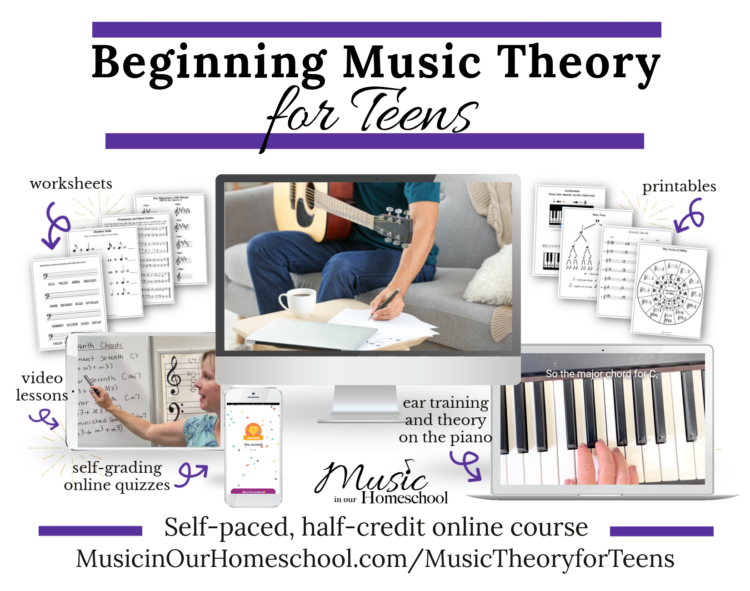
A self-paced music theory course
A music history course
A musicals appreciation class
Advanced analysis for motivated students
This allows your teen to grow without adding stress to your plate—and it shows them that learning can come from many voices, not just mom.
Encouragement for the Homeschool Mom
If you’re worried that you’ve missed your chance, let me reassure you: you haven’t.
Sometimes all it takes is one meaningful musical experience—a song, a concert, a moment of harmony—to spark something that lasts a lifetime.
Music appreciation for teens doesn’t have to be complicated. It doesn’t have to be time-consuming. And it doesn’t have to be something you dread.
Keep it short. Keep it consistent. Keep it connected to their world.
And remember: you’re not doing this alone.
Music in your homeschool can be joyful, meaningful, and doable—even in the teenage years.
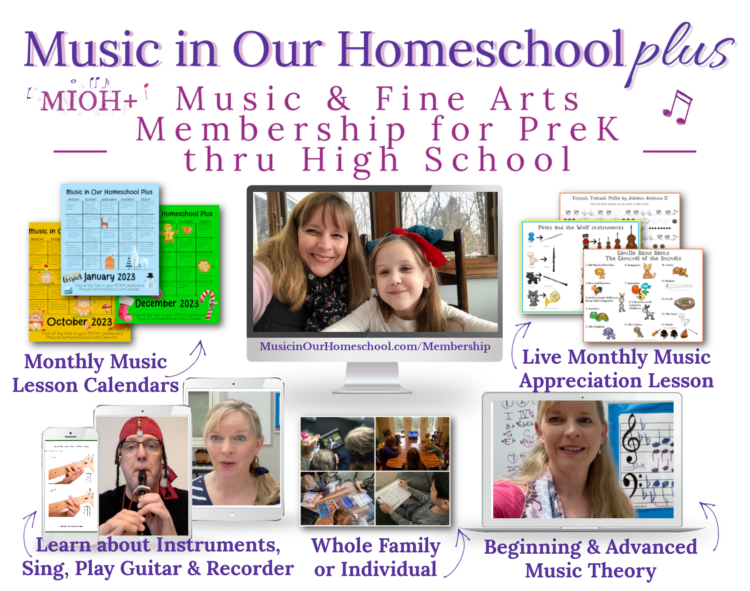
Head here to get the Basic Tier of the Music in Our Homeschool Plus membership!