There are some homeschool lessons that just stick—the kind your kids remember long after the day is over. Not because they were complicated or took hours to prepare, but because they connected to something deeper.
This is one of those lessons.
With Earth Day this week, it felt like the perfect opportunity to look at creation through both Scripture and music. Genesis 1 gives us the beautiful, foundational story of how God created the world, step by step. And what’s especially meaningful is that composers throughout history have been inspired by these same ideas—light, water, sky, animals—and have expressed them through music in powerful ways.
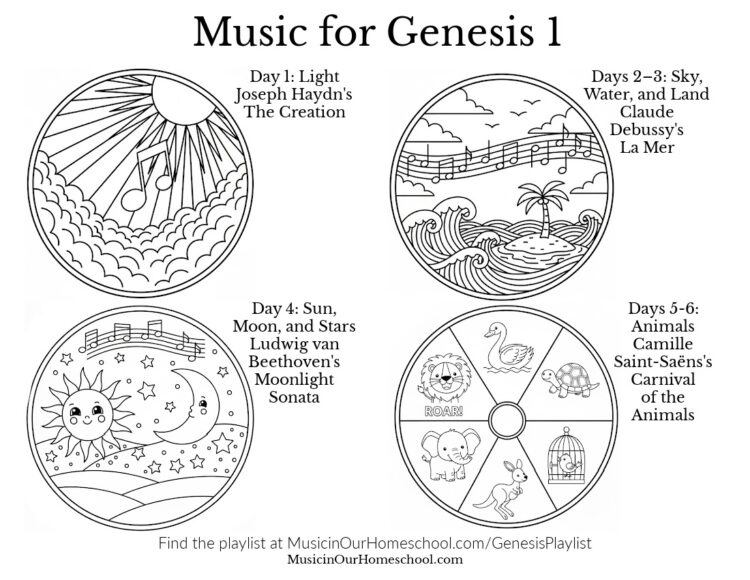
The result is a simple but rich experience you can share with your kids in just 15 minutes. (To make the lesson 15 minutes, listen to 3 minutes of Haydn, 3 minutes of Debussy, 2 minutes of Beethoven, and 7 minutes of Saint-Saens.)
You don’t need to be a music expert. You don’t need a detailed plan. Just a willingness to listen together.
Beginning with Darkness and Light
Genesis begins in a place that feels quiet and unformed. “The earth was without form and void, and darkness was over the face of the deep.” It’s a scene that almost feels still—but also full of anticipation.
Then comes one of the most dramatic moments in all of Scripture: “Let there be light.”
To hear this musically, there’s no better place to start than Joseph Haydn’s The Creation. This large choral and orchestral work opens with a section that represents chaos. The music doesn’t feel settled. It wanders, almost uncertain, as if it’s searching for something.
And then, suddenly, everything changes.
When the music reaches the moment of light, the orchestra bursts into a bright, full chord that feels like a breakthrough. Even young children can sense the difference. Before, the music feels dark and unsettled. After, it feels clear, strong, and full.
That contrast is something you can talk about with your kids. Ask them what they noticed. Did the music feel different before and after? Could they “hear” the light?
This is one of the simplest ways to introduce the idea that music tells a story—even without words.
The Movement of Water and Sky
As the days of creation continue, we begin to see movement. The waters are formed, the sky is separated, and the world begins to take shape.
For this part of the lesson, Claude Debussy’s La Mer is a beautiful choice.
Debussy’s music doesn’t tell a story in the same way Haydn’s does. Instead, it creates an atmosphere. It gives you the feeling of something rather than a clear narrative. This style, known as Impressionism, is a wonderful way to stretch your children’s listening skills.
As you listen, invite your kids to imagine what they hear.
Some may picture gentle waves rolling in. Others might imagine sunlight reflecting on the water. Some might notice how the music seems to shimmer or shift, like something alive and constantly changing.
There isn’t one right answer here, and that’s part of what makes this so valuable. Your children are learning to listen carefully, to interpret, and to express their own ideas—all through music.
The Peace of the Night Sky
By the time we reach day four in Genesis, the sun, moon, and stars are created. There’s a sense of order and calm that settles in after the earlier movement of creation.
To reflect this, Ludwig van Beethoven’s Moonlight Sonata offers a completely different musical experience.
Where Haydn was bold and dramatic, and Debussy was flowing and imaginative, Beethoven here is quiet and reflective. The music moves gently, with repeating patterns that create a sense of stillness.
This is a wonderful moment in the lesson to simply pause and listen.
You might ask your children what the music makes them think of. Do they picture a quiet night? A still lake? Stars in the sky?
Even if they don’t have words for it, they are learning something important: that music can express emotion and atmosphere in a way that words sometimes cannot.
The Joy and Creativity of Living Creatures
Finally, we arrive at days five and six, when the world is filled with living creatures—birds, fish, and animals of all kinds.
This is where the lesson often becomes the most fun.
Camille Saint-Saëns’ Carnival of the Animals is a perfect way to explore this part of creation. Each short piece represents a different animal, and the music is full of personality.
The swan moves smoothly and gracefully. The tortoises are slow and heavy in an almost humorous way. The birds flutter quickly with light, high sounds.
This is a great opportunity to make the lesson interactive.
You can ask your kids to guess which animal they hear. Younger children might enjoy moving like the animals while the music plays. Older students can listen for how the composer uses tempo, pitch, and instruments to create each character.
Without even realizing it, they’re learning important musical concepts—fast and slow, high and low, loud and soft—all through listening and play.
Why This 15-Minute Music Lesson Works
What makes this lesson so effective isn’t just the music or even the connection to Genesis. It’s the simplicity.
So often, we feel like we need to do more in our homeschool. More subjects, more depth, more structure. But in reality, it’s often the small, consistent moments that make the biggest difference.
This is exactly why I created the 15-Minute Music Method.
Short, focused lessons that you can actually fit into your day. Experiences that are rich and meaningful, but don’t require hours of preparation. Opportunities to build a love of music over time, one small step at a time.
And perhaps most importantly, it’s something you can do together.
You don’t have to explain everything perfectly. You don’t have to know all the answers. Just sit, listen, and let your children share what they hear and imagine.
That’s where the real learning happens.
How to Use This in Your Homeschool
This lesson fits beautifully into Morning Time, but it can also work anytime you need something meaningful and calm in your day.
You might read a portion of Genesis 1, listen to one piece of music, and talk about it briefly. Or, if you have a little more time, you can listen to several pieces and compare them.
There’s no pressure to do it all at once. Even one piece is enough.
If you’d like to hear the exact music selections used in this lesson, be sure to check out the accompanying post where everything is linked and ready to play.
And if you’re looking for more simple, no-prep lessons like this, you can get started with my free 15-Minute Music Lessons at MusicinOurHomeschool.com/FreeMusicLessons.
These are designed to help you easily include music and fine arts in your homeschool—even on your busiest days.
Because music doesn’t have to be complicated to be meaningful.
Sometimes, it just starts with pressing play.
Here's a Freebie of some more Composers to Listen to in Your Homeschool
Purchase the April 2026 LIVE Music & Painting Lessons here:
The 30-minute Music Appreciation/Composer Study Lesson is Inside the Music of a Magical Broadway Hit with composer Stephen Schwartz
The 1-hour step-by-step painting tutorial lesson is called “Hummingbird Haven.”
April LIVE Music and Painting Lessons
LIVE interactive 30-minute music appreciation and composer study lesson, plus a 1-hour acrylic step-by-step painting lesson.