Have you ever wanted to include more music education in your homeschool but weren’t sure where to start?
You’re not alone.
Many homeschool parents recognize the value of music appreciation, composer study, and basic music theory, but they often feel overwhelmed by the thought of teaching it. Maybe you don’t have a musical background yourself. Maybe your schedule is already packed. Or perhaps you’ve tried music lessons before and found that your children weren’t very engaged.
The good news is that music education doesn’t have to be complicated.
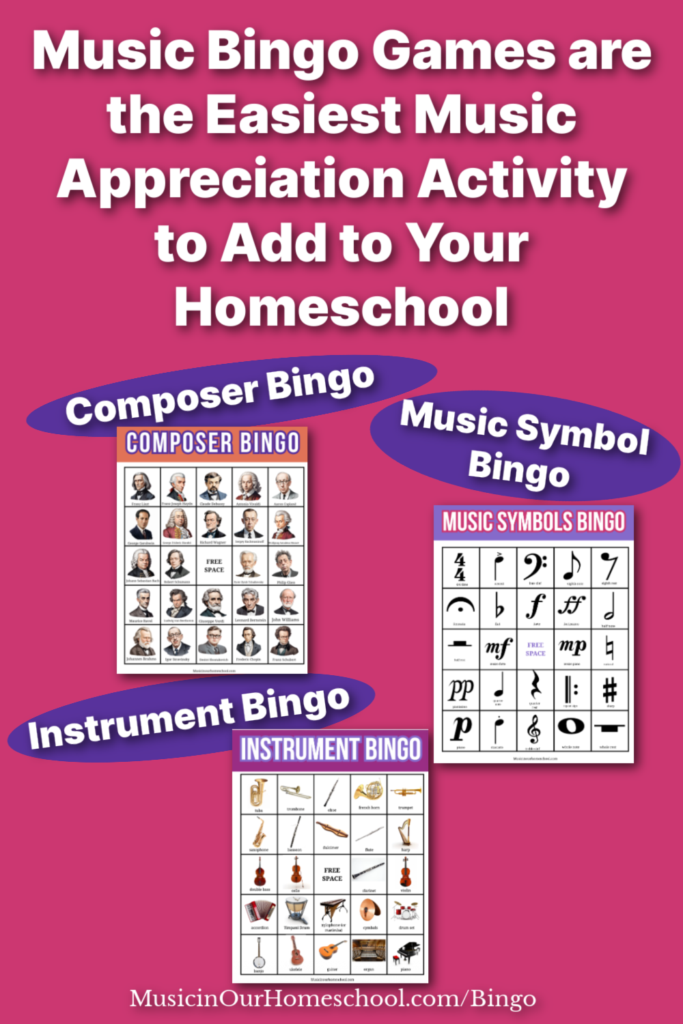
In fact, one of the simplest and most effective ways to teach music appreciation is through games. That’s why I’m excited to share three new Music Bingo Games that make learning about music fun, interactive, and memorable.
These no-prep printable games are perfect for homeschool families, co-ops, music classes, summer camps, Sunday school programs, and even family game nights.
Let’s take a closer look at how these music bingo cards can transform music education in your homeschool.
Children naturally learn through play. When kids are having fun, they’re more engaged, more attentive, and more likely to retain information. Instead of feeling like they’re completing another school assignment, they experience learning as an enjoyable activity.
Games also create a low-pressure environment where children can practice skills repeatedly without becoming bored. Every time they play, they’re reinforcing concepts and building confidence. For homeschool families, games offer another huge benefit: they work beautifully with multiple ages.
Younger children can participate at a basic level by matching pictures or symbols, while older students can deepen their understanding through listening activities, historical connections, and more advanced challenges. That’s exactly why Music Bingo Games have become one of my favorite music appreciation activities.
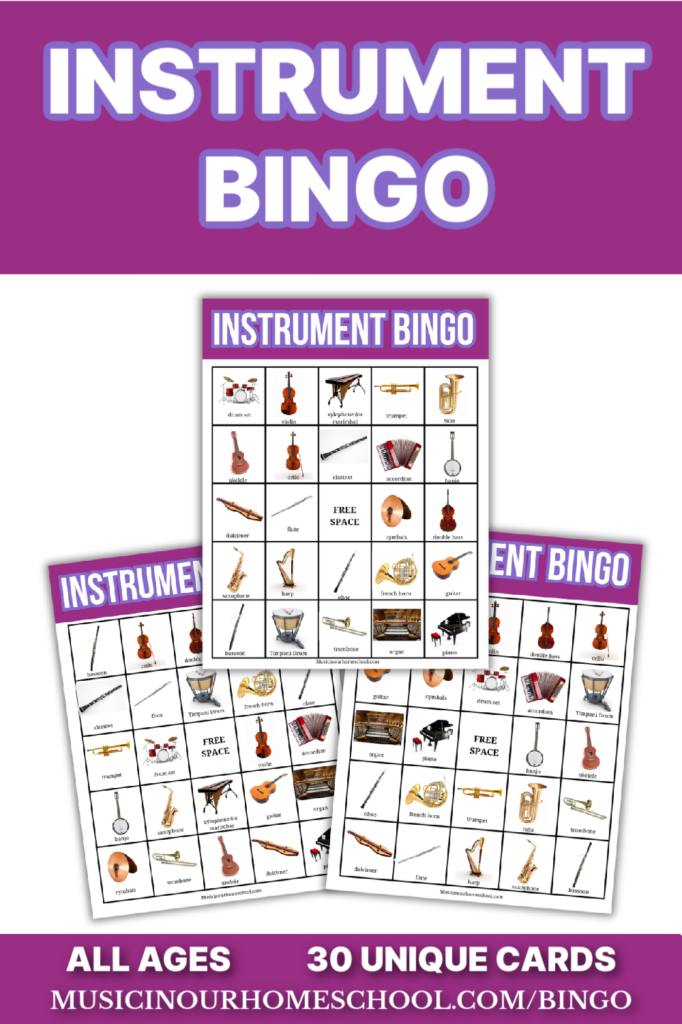
Musical Instruments Bingo Game
One of the foundational skills in music appreciation is learning to recognize musical instruments. When your children listen to an orchestra, band, ensemble, or even music on the radio, it’s helpful if they can identify what they’re hearing.
Is that a flute? A trumpet? A violin? A bassoon? The more familiar students become with instruments, the more actively they listen to music.
One thing I love about this collection is that it introduces children to all four major instrument families.
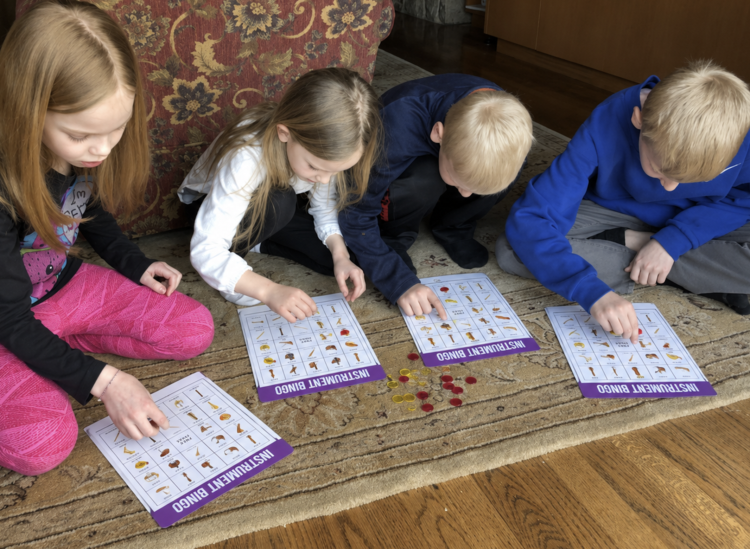
Students encounter woodwinds such as the flute, clarinet, oboe, and bassoon. They learn about brass instruments like the trumpet, trombone, tuba, and French horn. They become familiar with string instruments such as the violin, cello, double bass, harp, and guitar. They also learn percussion instruments including the xylophone, timpani, cymbals, and drum set.
In addition, children are introduced to folk instruments like the banjo, dulcimer, and accordion, as well as keyboard instruments such as the piano and organ.
How can I do music bingo?
The simplest way to begin is by calling out the name of an instrument and having students locate it on their bingo board. As they play, they’ll naturally become familiar with the instrument’s appearance, spelling, and name.
Once they’ve mastered that level, try a listening challenge. Search YouTube for short instrument demonstrations and play a few seconds of sound. Let students identify the instrument by listening alone.
This extension activity strengthens listening skills and helps children begin recognizing instruments by ear—a key goal of music appreciation.
Music Composers Bingo Game
Composer study is one of the most valuable aspects of music appreciation. When children become familiar with composers, they begin making connections between music, history, geography, culture, and artistic styles.
Unfortunately, memorizing a list of names from a textbook isn’t usually very exciting. Playing bingo, however, is a different story.
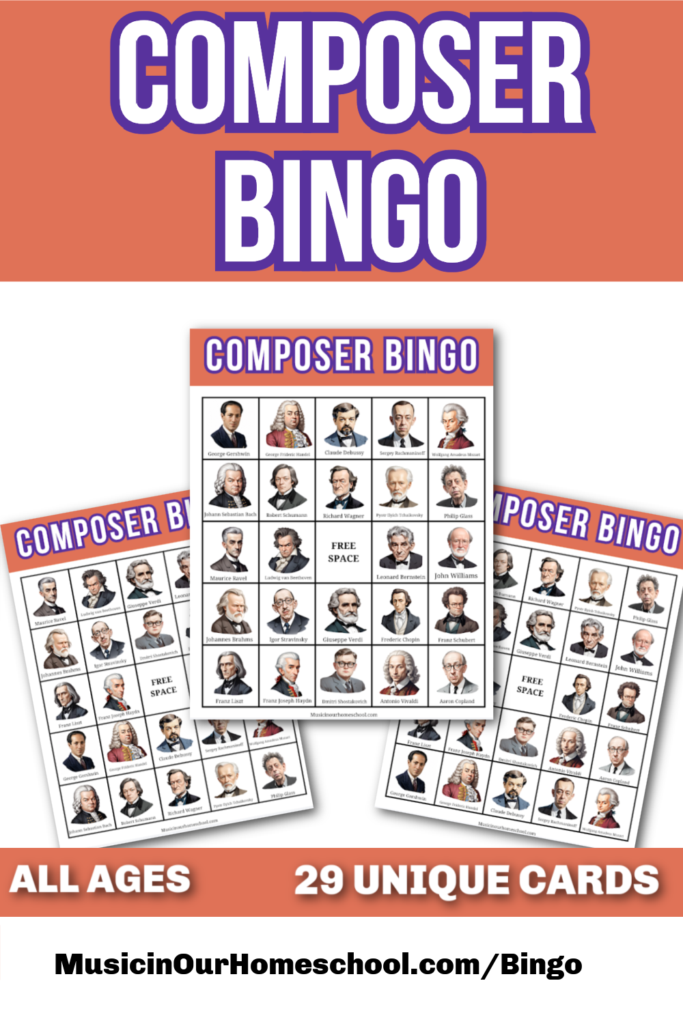
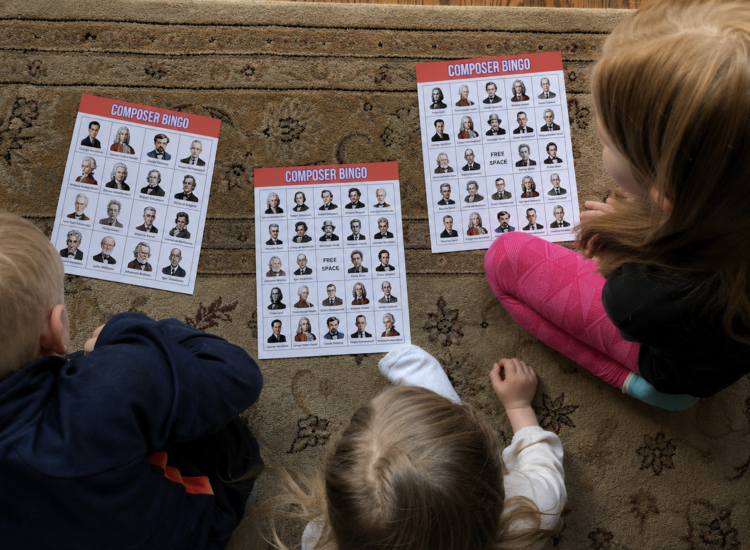
The Music Composers Bingo Game includes 29 unique bingo boards and introduces students to 24 famous composers:
Bach
Beethoven
Bernstein
Brahms
Chopin
Copland
Debussy
Gershwin
Glass
Handel
Haydn
Liszt
Mozart
Rachmaninoff
Ravel
Schubert
Robert Schumann
Shostakovich
Stravinsky
Tchaikovsky
Verdi
Vivaldi
Wagner
John Williams
This collection spans every major era of Western classical music.
Students encounter Baroque composers like Bach, Handel, and Vivaldi. They learn about Classical-era masters Mozart and Haydn. They discover Romantic composers such as Beethoven, Brahms, Chopin, and Liszt. They also explore modern composers including Bernstein, Copland, Gershwin, Philip Glass, and John Williams.
The game naturally opens doors to geography as well.
Students learn that Mozart was from Austria, Tchaikovsky from Russia, Vivaldi from Italy, Ravel from France, and John Williams from the United States.
What are some variations of music bingo?
Begin by simply calling out the composers’ names. Students will become familiar with each composer’s face, name, and spelling through repeated play.
Later, add a listening component. Play a short excerpt from a famous piece and challenge students to identify the composer.
For example:
“Eine Kleine Nachtmusik” — Mozart
“Rhapsody in Blue” — Gershwin
“The Four Seasons” — Vivaldi
“Hedwig’s Theme” — John Williams
This turns the game into an engaging music appreciation activity that develops listening skills and musical memory. Before long, your children may surprise you by recognizing composers they’ve never formally studied before. Find a Music Composer Bingo Spotify Playlist here.
Musical Symbols Bingo Game
Many homeschool parents feel intimidated by music theory. Perhaps you never learned to read music yourself, and you’re worried about teaching concepts you don’t fully understand.
The good news is that you don’t need to be an expert. The Musical Symbols Bingo Game allows you to learn right alongside your children.
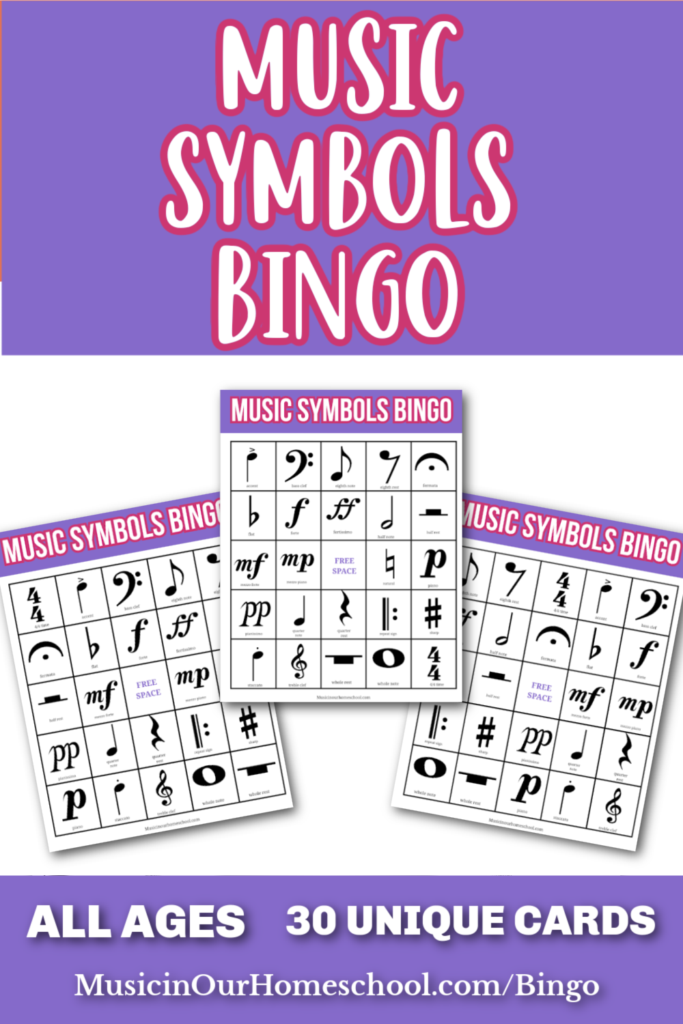
This game introduces 24 essential music symbols, including:
Treble Clef
Bass Clef
Quarter Note
Half Note
Whole Note
Eighth Note
Quarter Rest
Half Rest
Whole Rest
Eighth Rest
Sharp
Flat
Natural
Forte
Piano
Mezzo Forte
Mezzo Piano
Fortissimo
Pianissimo
Accent
Staccato
Fermata
Repeat Sign
4/4 Time Signature
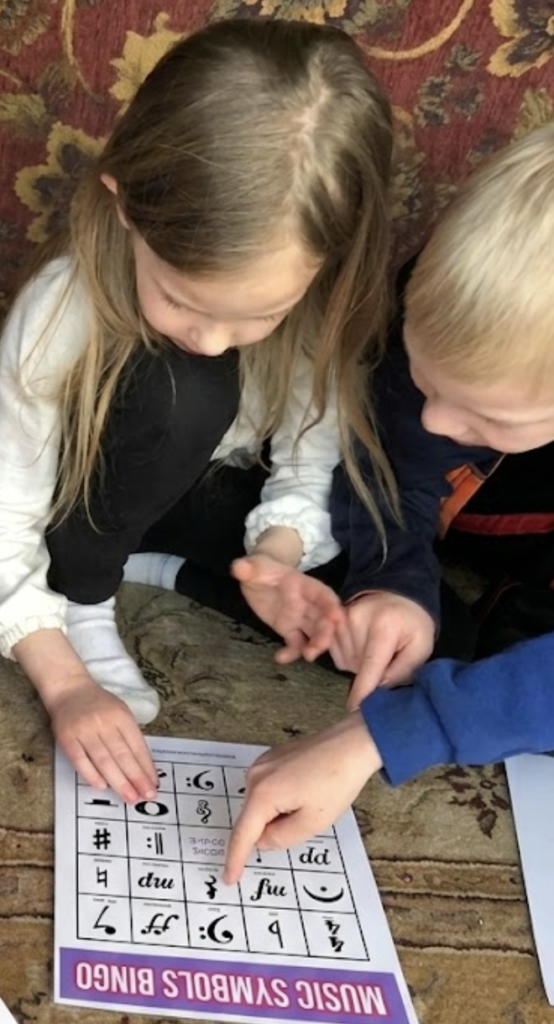
Students repeatedly see each symbol and its name while playing. Over time, they begin recognizing symbols automatically. This is a far more engaging approach than simply filling out worksheets.
Children learn musical vocabulary naturally through repetition and play. And because the symbols appear repeatedly throughout the game, students develop familiarity without feeling overwhelmed.
How Music Bingo Fits Into Your Homeschool
One of the best things about these Music Bingo Games is their flexibility.
You can use them in a variety of ways:
Friday Fun Day activities
Music appreciation lessons
Co-op classes
Family game nights
Morning basket time
Learning centers
Review activities
Substitute plans
Summer learning
Because the games require virtually no preparation, they’re ideal for busy homeschool moms who want meaningful learning without adding more work to their day.
Simply print the boards, laminate if desired, cut out the calling cards, and you’re ready to play.
Learning Through Consistency
Sometimes we think education has to be complicated to be effective. But often the opposite is true.
A game played once is fun. A game played consistently throughout the year becomes a powerful learning tool. Each time your children play, they’re reinforcing important concepts and building lasting musical knowledge.
They’ll become familiar with instruments, composers, and music symbols almost effortlessly because they’re learning through enjoyable repetition.
That’s one of the reasons I love music appreciation so much. It doesn’t have to be difficult to be meaningful.
Ready to Make Music Appreciation Easy?
If you’ve been looking for a simple, enjoyable way to add music education to your homeschool, Music Bingo Games are a wonderful place to start.
Here is a music bingo playlist you can use for the more advanced listening aspect for Composer Bingo:
Or, if you want a list of the composers and pieces:
Composer
Piece
Johann Sebastian Bach
Jesu, Joy of Man’s Desiring (from Cantata No. 147)
Ludwig van Beethoven
Symphony No. 5 in C Minor
Leonard Bernstein
Symphonic Dances from West Side Story
Johannes Brahms
Hungarian Dance No. 5
Frédéric Chopin
Nocturne in E-flat Major, Op. 9 No. 2
Aaron Copland
Hoe-Down (from Rodeo)
Claude Debussy
Clair de Lune
George Gershwin
Rhapsody in Blue
Philip Glass
Truman Sleeps (The Truman Show)
George Frideric Handel
Hallelujah Chorus (Messiah)
Joseph Haydn
Surprise Symphony (Symphony No. 94, Andante)
Franz Liszt
Liebestraum No. 3
Wolfgang Amadeus Mozart
Eine kleine Nachtmusik
Sergei Rachmaninoff
Rhapsody on a Theme of Paganini, Variation 18
Maurice Ravel
Boléro
Franz Schubert
Ave Maria
Robert Schumann
Kinderszenen (Scenes from Childhood)
Dmitri Shostakovich
Waltz No. 2
Igor Stravinsky
The Rite of Spring (Introduction)
Pyotr Ilyich Tchaikovsky
Swan Lake, Act II Scene
Giuseppe Verdi
La donna è mobile (Rigoletto)
Antonio Vivaldi
Summer, from The Four Seasons
Richard Wagner
Ride of the Valkyries
John Williams
Hedwig’s Theme (Harry Potter)
Are there any other music bingo playlists you'd like me to create? Leave a comment below and let me know!
Freebie: Study a Composer pack
Download the Study a Composer pack to use with today's music lesson here:
Music in Our Homeschool Plus membership
If you'd like a 15-minute music lesson like this every day in the Music Lesson Calendar of the Month, click here to join the Music in Our Homeschool Plus Membership!