Each December, music fills our homes, churches, store visits, and car rides. But behind every familiar Christmas tune is a story—sometimes one of faith, sometimes of history, sometimes of pure joy.
Today, let’s discover the stories behind five of the most beloved Christmas carols of all time and explore creative ways to share them in your homeschool. You’ll find that these carols are more than melodies—they’re living lessons in music appreciation, world history, and cultural connection.
Christmas music has a way of filling our homes with warmth, nostalgia, and a sense of sacred beauty. But behind the melodies we sing every December are stories—real moments in history, unexpected circumstances, faithful believers, creative artists, and musical traditions passed down for centuries.
When we slow down long enough to share these stories with our children, Christmas carols take on a new layer of meaning. They become more than seasonal background music. They become history lessons, faith lessons, literature studies, geography connections, and beautiful opportunities for relationship and reflection. This is especially true during December when many families shift into “Christmas School,” pressing pause on the usual curriculum and doing something more restful and joyful.
Below are the stories behind five classic Christmas songs that have shaped the season for generations. Each section also includes simple ideas your family can use to turn these stories into a music appreciation lesson at home.
1. Silent Night
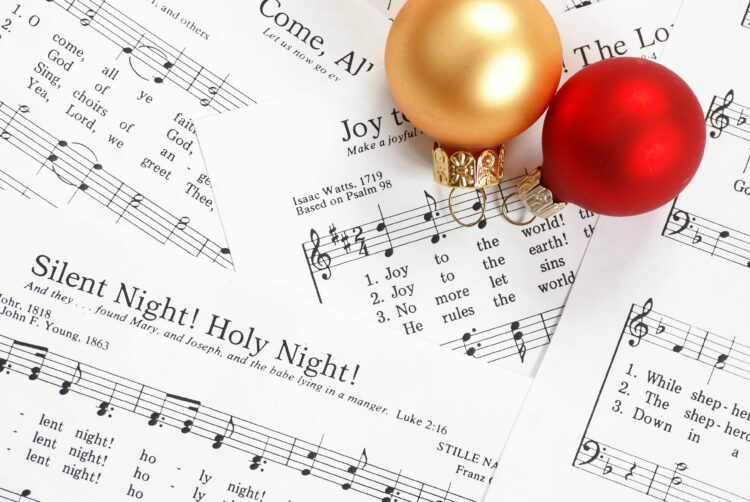
“Silent Night” is one of the most beloved carols in the world, but its beginnings were wonderfully humble. On Christmas Eve in 1818, the people of Oberndorf, Austria, were preparing for their midnight service at St. Nicholas Church. But there was a problem: the organ was broken. The church could not use its primary instrument for the most anticipated service of the year.
Priest Joseph Mohr, just 26 years old at the time, remembered a poem he had written after a walk through a quiet, snow-covered forest. He brought the poem to Franz Gruber, a local schoolteacher and church musician, and asked him to write a melody that could be accompanied by guitar.
Within hours, Gruber composed the tune we know today—calm, gentle, and filled with a sense of stillness befitting its title. That evening, the two men performed Silent Night for the first time, Mohr on guitar and Gruber singing harmony.
Over the next few decades, traveling folk singers carried the carol across Europe. By 1839, it had reached America. Today, “Silent Night” has been translated into more than 300 languages and is sung around the world on Christmas Eve, often accompanied by candlelight.
Homeschool idea: Invite your kids to imagine the candlelit church on that snowy evening. Let them create illustrations, write a short narrative, or even perform “Silent Night” using a simple instrument like ukulele, guitar, or glockenspiel.
“Joy to the World” is one of the most triumphant and energetic carols we sing, but the story behind it stretches across centuries.
The lyrics were written by Isaac Watts in 1719 as a poetic paraphrase of Psalm 98. Watts was passionate about helping congregations sing Scripture in language that felt fresh and understandable. His paraphrase praises the Lord’s coming—but not specifically His birth. In fact, Watts was writing more about Christ’s second coming than His arrival in Bethlehem.
More than a hundred years later, American composer Lowell Mason crafted a new melody, drawing inspiration from the musical style of Handel. Mason’s tune captured the joyful boldness of Watts’s text, and the result was electric. Churches adopted “Joy to the World” during Advent and Christmas simply because the mood fit so beautifully.
Today, we think of “Joy to the World” as a Christmas anthem, full of celebration and proclamation—an example of how a text and tune from entirely different eras can come together to form something timeless.
Homeschool idea: Have children read Psalm 98 and then compare the Scripture with Isaac Watts’s paraphrase. This activity blends Bible study, language arts, and music appreciation into one short and meaningful lesson.
3. O Holy Night
Few Christmas carols have a story as dramatic as “O Holy Night.”
In 1847, French poet Placide Cappeau was asked by his parish priest to write a poem for Christmas Mass. Cappeau accepted, although he was not particularly connected to the church at the time. Drawing inspiration from the Nativity story in the Gospel of Luke, he produced a poem filled with awe, reverence, and a deep sense of longing.
He asked Adolphe Adam—a respected composer of opera and ballet—to write the music. Adam’s sweeping, emotional melody elevated the text, and the song spread rapidly.
However, controversy soon followed. When the church realized that Cappeau had distanced himself from the faith and that Adam was Jewish, leaders tried to suppress the carol. But “O Holy Night” had already become so beloved among the people that it continued to be sung in homes and gatherings throughout France.
Then, on December 24, 1906, “O Holy Night” entered history in an extraordinary way. Canadian inventor Reginald Fessenden, working on early radio technology, made the first transmission using the human voice. Listeners expected Morse code. Instead, they heard Fessenden reading Luke 2 and then playing “O Holy Night” on his violin. It was the first song ever broadcast on radio!
Homeschool idea: Ask your kids what it must have felt like to hear music through a radio for the first time. They can imagine the families gathered around early radios, listening in wonder as “O Holy Night” played unexpectedly across the airwaves.
4. The First Noel
“The First Noel” is one of the oldest English carols still sung today. Its exact origins are unknown, but scholars believe it began as a folk song in the late Middle Ages—likely sometime in the 1400s or 1500s. This was a time when very few households owned books, and even fewer people were trained musicians.
Because of that, Christmas songs were often passed down orally. Villagers sang them at community gatherings, during the Twelve Days of Christmas, or while going door to door. “The First Noel's” long, unfolding melody and repeated phrases reflect that oral tradition. They made the song easy to learn and easy to remember.
The word “Noel” comes from an old French word for “Christmas,” and ultimately from the Latin word for “birth.” This carol truly celebrates the “first Christmas,” retelling the story of the shepherds, the star, and the newborn King.
It wasn’t printed until 1823, when “The First Noel” finally appeared in a collection called “Christmas Carols Ancient and Modern.” By that point, dozens of versions existed, each slightly shaped by the regions and communities that sang it.
Homeschool idea: Discuss oral tradition with your children. Without playing a recording, teach them a simple melody by ear and let them experience what it’s like to learn music the way families once did.
5. Hark! The Herald Angels Sing
The story of “Hark! The Herald Angels Sing” shows how music can evolve across generations.
Charles Wesley wrote the original hymn in 1739. Wesley was a prolific writer who penned more than 6,000 hymns during his lifetime. His first line, however, was very different from what we sing now: “Hark! how all the welkin rings.” The word “welkin” referred to the heavens, but it was not commonly understood.
Evangelist George Whitefield, leader of the Great Awakening in America, updated the text in 1753, replacing “welkin” with “the herald angels” so congregations could grasp the meaning more easily. His revision is the version we recognize today.
But the tune still had not been written.
German composer Felix Mendelssohn composed a bright, energetic melody in 1840 to celebrate the 400th anniversary of Gutenberg’s printing press. He explicitly said the tune was not intended for sacred use. Yet fifteen years later, musician William Cummings felt it paired beautifully with Wesley’s text. He joined the two together, and almost instantly, the carol “Hark! The Herald Angels Sing” took root.
The result is one of the most triumphant Christmas hymns ever written—a blend of Wesley’s rich theology, Whitefield’s careful editing, and Mendelssohn’s joyful melody.
Homeschool idea: Show your children Wesley’s original lines and Whitefield’s revisions. Talk about how hymn texts sometimes change over time and how music can connect generations of believers.
Simple Ways to Use These Stories of Classic Christmas Carols in Your Homeschool
Here are several easy ways to use these carol histories as part of your Christmas School plans:
• Listen to two or three different arrangements of the same carol and compare what’s different • Invite kids to draw one scene described in a carol and share it at the dinner table • Read Luke 2 together and identify which carols were inspired by that passage • Talk about how music used to be learned by ear and experiment with teaching a melody orally • Explore world geography by locating the countries connected to each carol’s origin • Discuss how poetry, Scripture, and history all come together in Christmas music
These simple, thoughtful activities help children slow down and listen deeply—not just to the music, but to the meaning behind it.
Final Thoughts about Classic Christmas Carols
Christmas carols are beautiful, but their stories make them even richer. Whether your family sings them around the tree, hears them at church, or studies them as part of your Christmas School rhythm, these songs remind us of the long line of believers, musicians, and storytellers who have celebrated the birth of Christ throughout history.
I hope this deeper look at five classic Christmas songs helps you embrace the season with more joy, more understanding, and more music in your homeschool this year.
Looking for Ready-Made Christmas Music Lessons?Get Music of Christmas here:
Music of Christmas Course
Fun Music Lessons to Get You and Your Kids in the Holiday Spirit